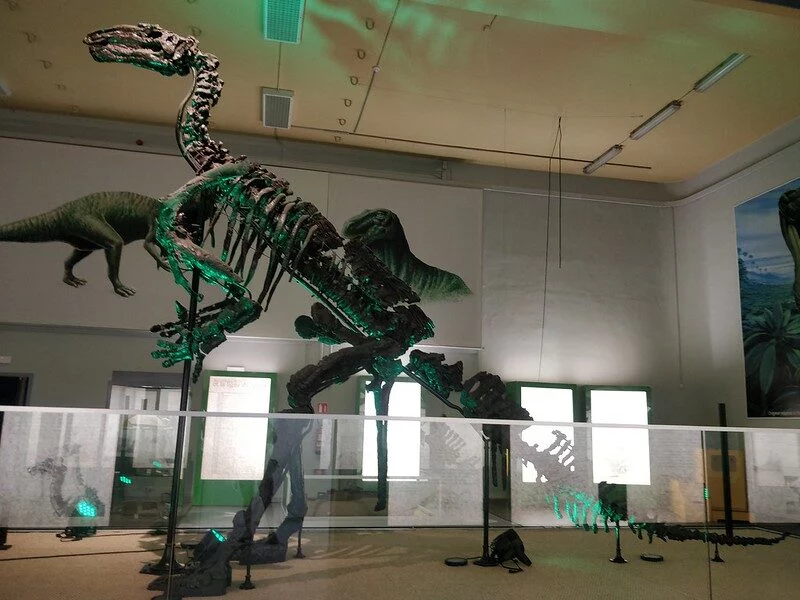
Sep 26: The Iguanodon Museum in Bernissart In the coal mines of Bernissart found 30 skeletons of iguanodons and numerous bones of prehistoric turtles, crocodiles and fish at a depth of 320 to 350 metres around the 1875s.
The excavations took three years and those finds were considered so important that engineer Louis De Pauw decided to take the skeletons to the Natural History Museum in Brusselssend.
This was no mean feat, as the giant bones were very fragile. As soon as they came into contact with air, they began to crumble. Therefore, they were immediately covered with a double layer of protective paper and cast in plaster. Each skeleton was given a letter of the alphabet, and all the individual bones were numbered in the correct order A1, A2,..... Some of those replastered bones weighed up to 1 tonne!
Those blocks, 600 in total, were placed in wooden crates and transported to Brussels by horse-drawn cart. That operation required 37 transports. Upon unpacking, the bones were immediately impregnated with a strong glue to prevent them from falling apart.
The entire undertaking, from discovery to research, shipping and reconstruction of the skeletons, took 25 years.
An iguanodon was 10 metres long, 5 metres high and weighed 5 tonnes. Not a creature to keep in your backyard....