Compassion Rising Tour 2025: Helsinki + Lübeck

Panoramic Helsinki

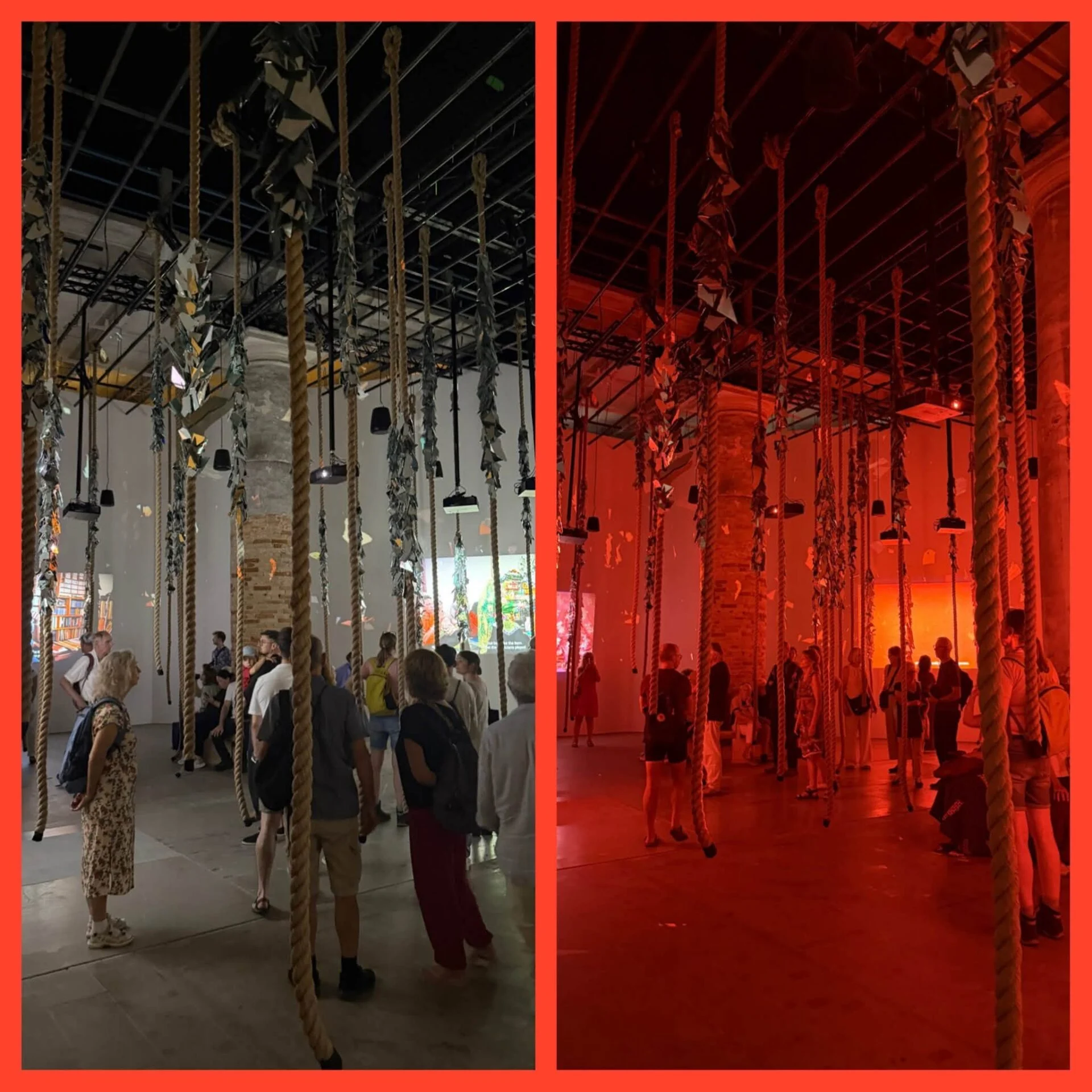
17-19 September: third edition of the Helsinki Biennial of Contemporary Art

On the way from the ferry terminal to my hostel, there was a poster for the Helsinki Art Biennale, which was in its very last week. On Sunday it would come to an end. What a windfall that I was just in time.
 
The biennial took place in three locations: In the Esplanade Park (five artists), Vallisaari island (25 artists) and the Helsinki Art Museum (HAM - 15 artists).
I visited the three venues and did a fairly extensive reportage. What struck me was that two-thirds of the artists were women. So were the two curators, perhaps that had something to do with it.
 
The theme of the biennial was 'Shelter'. It took its inspiration from the flora and fauna of the former military fortress island of Vallisaari, now uninhabited for decades and given back to nature. In the 1950s, a village community of 250 still lived here, with a school and several cafes.
 
The biennial reflected on the fragile relationship between humans and nature. The artworks went beyond the anthropocentric perspective. The curators questioned human dominance by foregrounding non-human actors such as plants, animals, fungi and minerals. They believe that this perspective shift can bring a new awareness, with more compassion and respect for other living beings. The biennial aims to create new conservation spaces and encourage positive environmental action.

'Tidal Tears' by Hans Rosenström (Vallisaari island) 

Against the backdrop of the global environmental crisis and climate change, the Biennale calls for new ways of thinking that approach ecology and climate issues holistically. For this reason, artists from indigenous communities, such as the Sami and South American Indians, were also invited.
 
The artists' work ranges from microscopic research - algae, bacteria, compost worms... to broader speculative reinterpretations of possible futures.
 
In the Flickr photo album, under each photo there is a link to the artist's biography and more information about his/her inspiration and artistic research. It is advisable to read that info to better place the creation of the works.
 
Two works that gutted me were 'Stranding', images of washed-up dolphins made from waste plastic, and the hushed video in soft grey tones 'Teardrops of my grandmother', in which the Sami artist says her life will also end when her arctic habitat disappears due to climate change. I watched that one twice. So beautifully filmed.

'Stranding' by Sara Bjarland (Vallisaari island) 

20-21 September: Helsinki - Travemünde (DE) by boat

This is the longest boat trip I have ever made: 31 hours at sea. Departure Saturday at 3pm in Helsinki and arrival Sunday at 9pm local time (10pm Finnish time) in Travemünde.
 
When I booked this trip, the cheapest available cabin cost +€200. Excessive for one night's sleep. It was a cabin for 4 people, I didn't have that many beds. I then booked the cheapest option, a 'reclining chair', and took my own air mattress and sleeping bag up on the boat, hoping I would find somewhere to spread it.
 
This succeeded without any problem in a separate room with about 30 reclining chairs which I had all to myself except for one fellow passenger. Conveniently, I first tried lying on the seats of three contiguous seats, but that would undoubtedly lead to a ragged morning. The seats were very narrow and uncomfortable to lie on, and also too short. The seat rails could not be laid flat; they were not reclining chairs.
 
Between the ship's wall and the first row of chairs, I found a suitable place to install my bed somewhat out of sight, and slept wonderfully around the clock. With this, I caught up some sleep from the previous nights in Helsinki, where my sleep was often disturbed by the typical hostel noises.

Bed spread

The soft and regular roar of the ship's engines gave me a satisfying night's sleep.
 
In addition to 'sea stares', musing on the past voyage, looking ahead to what awaited me at home and strolling around a bit on the windy deck, I spent the long hours writing overdue posts. In reverse chronological order: Helsinki, my visit to a Buddhist centre in Tallinn, Riga and Vilnius. Posting the texts was impossible because there was no network at sea. 
 
And surprising coincidence: on Sunday afternoon, I watched the Belgium-Finland match at the World Volleyball Championships in the Philippines on Eurosport. Much to the chagrin of the Finns on board, Belgium won gloriously.
 
After arriving in Travemünde I still had to cycle 20 km to Lübeck. It did good to be moving again with the wind around my ears, after 31 hours virtually immobile on the boat. It included a few kilometres on an unlit gravel path next to a railway line. Only the bike light to follow the path, but fortunately this was quite strong and it was a gently sloping gravel path with few potholes. After about two kilometres, there was a crossing over the railway line and I could continue on the other side on a lit cycle path next to the carriageway all the way to Lübeck.
 
At 10 p.m. and with a hostel boss waiting, as check-in was normally only possible until 10 p.m., I wasn't going to seek adventure in the dark.

Sailing route from Helsinki to Travemünde

September 22: Günter Grass house in Lübeck

I felt a little 'out-museumed' after three consecutive city visits - Tallinn, Helsinki and Lübeck - but for the Günter Grass house I made an exception. Until his death a decade ago, in 2015, the writer-Nobel Prize winner/visual artist lived here.
He was born in Danzig (Gdansk) when it was still a 'free city' under the auspices of the League of Nations (1920-39). A city I also visited earlier this tour.
 
Grass's life story is well documented on the internet, which I am not going to put down here.
However, I did take some photos of his visual work, as I suspected it was less well known than his books.
Günter Grass is known among others as the author of 'Die Blechtrommel' filmed by Volker Schlöndorff in 1979.

5x Oskar out 'Die Blechtrommel'

22-24 September: Lübeck - 2 museums and city tour

Hanging around Lübeck for three days, waiting for a FlixBus that could take my bike. An unplanned city visit. Actually, those three days were a bit too much. Fortunately, the weather was nice.
 
After the Günter Grass house, I visited the Willy Brandt museum and and the European Hansa Museum. In the first, I learned that Willy Brandt was born Herbert Frahm, but changed his name to Willy Brandt when the Nazis came to power in 1933. He fled the repression of Socialists and Communists and moved to Norway via Denmark. In 1938, the Nazis took away his German citizenship and in 1940 he was granted Norwegian citizenship. After the Nazis invaded Norway, he fled to Sweden.
 
After the war, he returned to Germany and, to make a long story short, that was the beginning of his successful political career as an SPD politician, convinced European and international peace envoy, for which he was awarded the Nobel Prize in 1971.
 
On Wednesday, my bus would not leave until 9pm and I wandered through the European Hanse Museum again in the afternoon. An impressive presentation, but the abundance of information was beyond me. Actually, I still enjoyed most the quiet and serene Dominican Monastery that was also included in the ticket.

Düvekenstraße

Share this post on social media

Read more...

en_GB