Compassion Rising Tour 2025: Arvo Pärt Centre

Arvo Pärt centre

September 14: Arvo Pärt centre in Laulasmaa

Sunday was my only chance to get as far as the Arvo Pärt centre, as it is closed on Mondays and Tuesdays. The forested Laulasmaa peninsula where the centre is located is a 50-minute bus ride from Tallinn. It is where Heinz Eller, Pärt's teacher, stayed in summers. Pärt regularly visited him there, hence his special connection with this location. The silence and peace that reign there provide the right framework for his hushed compositions.
 
The centre was designed by Spanish firm Nieto Sobejano Arquitectos, which won the previously launched architectural competition. It opened its doors to the public in October 2018. Its main function is to house the large Pärt archive.

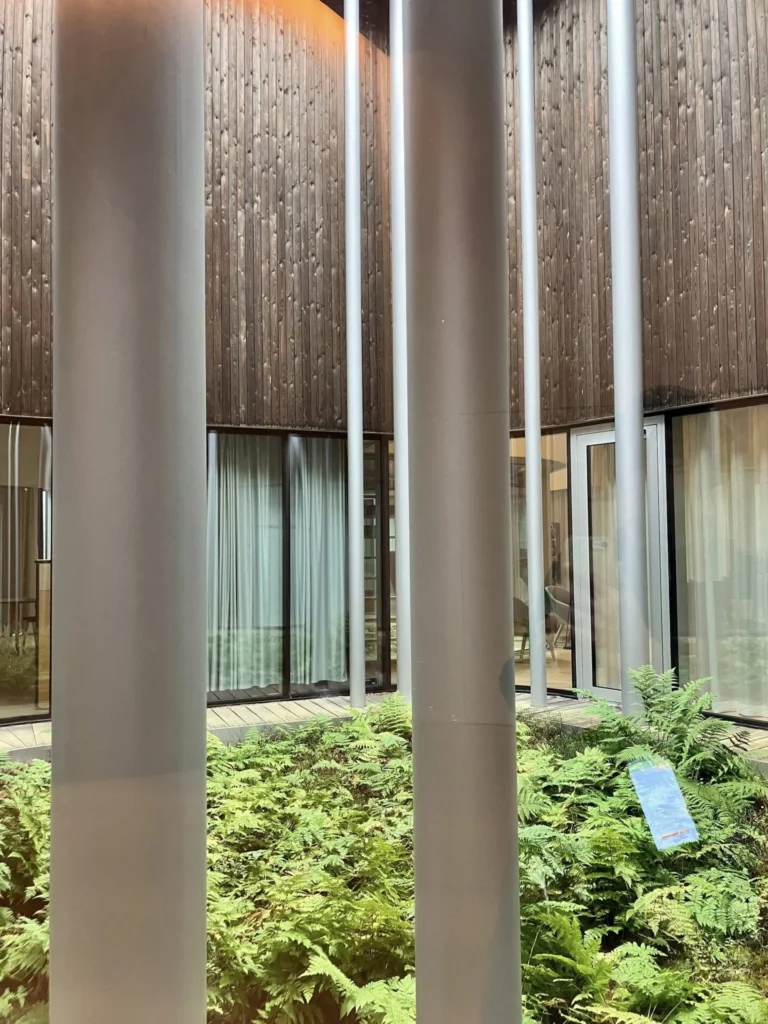
5-cornered patio as a symbol of silence and forest

Several pentagonal patios in the building's structure symbolise the silences in Pärt's music. The columns have different thicknesses, like the trees in a forest.

Close to the entrance is a wall with photos of Pärt's music publishers and performers who perform his work most cleanly.
 
An austere concert hall offers 151 seats and has incredible acoustics.
 
There is also a library with his personal collection of 2,000 music, art and theology books.
 
In his early years, Pärt composed mainly modernist serial works. After Credo (1968), a composition in which he confessed to the Orthodox Church, he clashed with the atheistic Soviet authorities and his work was no longer allowed to be performed. After that, he reached an impasse. He renounced his earlier musical style and ended up in a creative crisis that would last eight years.
 
He threw himself into an intensive study of Gregorian and medieval music and eventually developed his own style that he called 'tintinnabuli', which means 'little bells' in Latin. Tintinnabuli combines two monodic lines of music: a melodic line and below it a triadic line of three notes each. It is concentrated music, leaving only the very essentials.
 
For Pärt, the melodic voice represents the sins he committed, while the triadic line beneath it forgives and wipes out those sins.
The 'formula' Pärt attributed to tintinnabuli is 1+1=1. That is, there is an inherent duality, but the two components form an inseparable whole. It is the audible expression of the temporary and the timeless, the physical and the spiritual, the subjective and objective, the earthly and heavenly, the negative and positive, the dynamic and static.
Pärt feels responsible for the impact of his music on the mind of the listener. Therefore, he considers every musical decision very deeply.
Well-known examples of Tintinnabuli are Für Aline, Fratres, Tabula Rasa and Spiegel im spiegel.
 

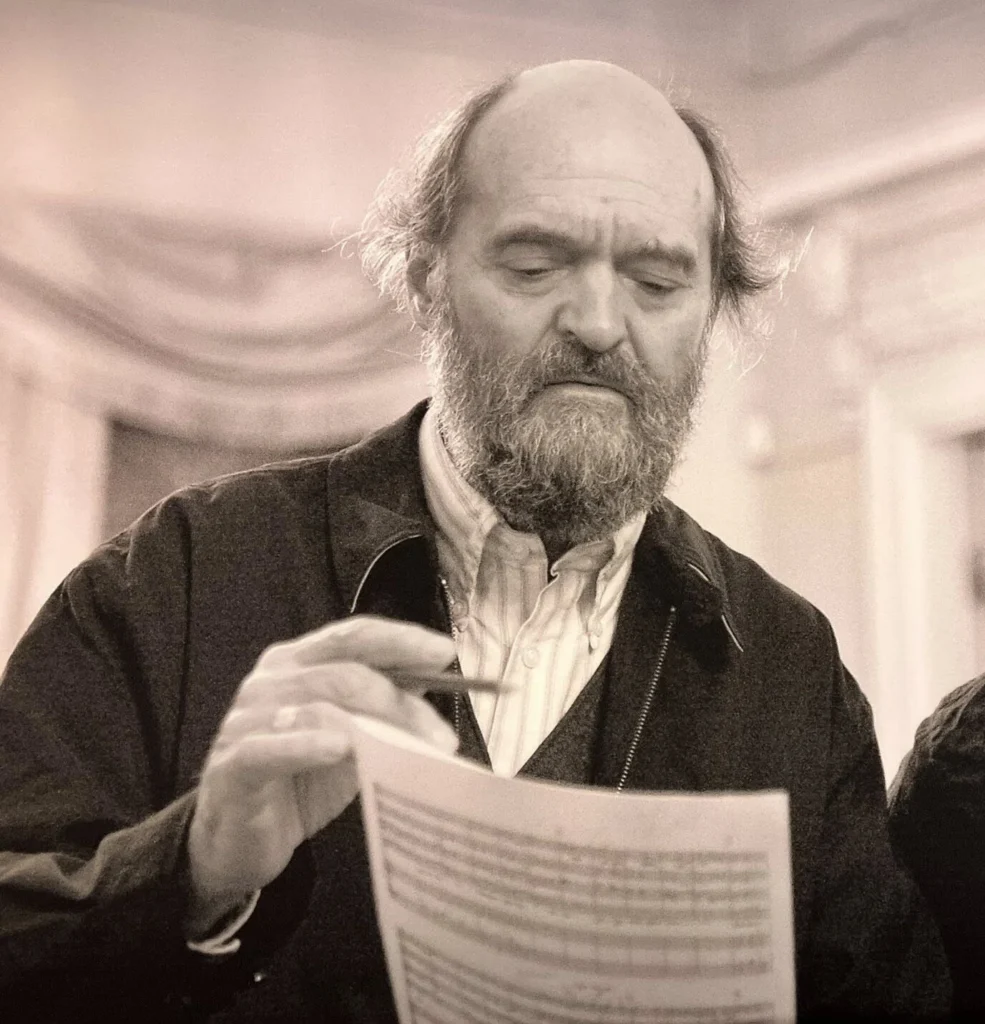
Arvo Pärt

At the back of the library was a large, unfolded book that struck me as a magical magic book. Thanks to that book, I learned a lot about Pärt's music.
 
A brightly lit circle is projected on the first page. When you point it out, audio starts and images are projected on the page. When you turn a leaf, everything stops and you get a new circle of light for another presentation. For scores, illuminated spheres follow the notes played on the sheet. That projection made me understand a little better how the tintinnabuli technique works.
 
Pärt's music is mostly based on religious texts. The words (the rhythm, syllables, etc) are translated directly into music. Even to his instrumental music, such as Silouan's songs and his fourth symphony, underpins a text.
 
I don't know how long I sat browsing and listening and reading in that book, but suddenly I saw that it was already half past four....
 
Pärt's religious work was not allowed to be performed by the Soviets and he fell without means of livelihood. In 1980 he emigrated, first to Vienna and the following year to Berlin, where he lived and worked for 30 years. After independence in 1991, he re-established ties with Estonia and Estonian orchestras, returning to his homeland in 2010.
Share this post on social media

Read more...

en_GB