Bike tour 2023: Lisbon

27 - 29 March: Stay in Lisbon
Spend a few days soaking up culture in Lisbon.

27 March: Day 1 Lisbon
Today I took it easy. I went to the tourism office and bought a 48-hour city pass that I will activate tomorrow.

For the rest, I strolled around the Baixa district, took a look at the hall of the south-east river terminal, where eight companies offered river trips on the Tagus. The hall was charming: each counter was decorated with a large ceramic coat of arms of a Portuguese city. The building also houses the Centro Tejo, a multimedia presentation of the river and its surroundings.(33.8 km -270 D+)

I then walked north to the Rossio square and to the Avenida da Liberdade. Rossio train station is a beautiful neo-Manuel style building, derived from the late Gothic Manueline style.

Rossio Square

What struck me is the large number of abandoned and dilapidated houses in the city, even on the prestigious Avenida da Liberdade where all the expensive branded shops were concentrated. On the internet, I read that there are 48,000 empty homes in the city. Young families are moving away from the city centre because there are not enough facilities like schools and childcare for them in the old town.
Lisbon is a commuter city: 400,000 cars enter the city every day, while there are only 160,000 cars with Lisbon license plates (2010 figures).
After dinner at Os Tibetanos Restaurante (see also link at Facebook) I walked back along the other side of the wide Avenida da Liberdade and took a picture of the beautifully lit Eden Teatro, which is now a luxury hotel.

28 March: Lisbon day 2
The Santa Justa lift is just around the corner from my hostel, so I decided to start my tour at the Carmo monastery (1389) and the archaeological museum, which is located right by the lift exit. There was quite a queue waiting at the lift entrance. Only one of the two cabins was working.

The monastery's church lost its roof during the 1755 earthquake and was not rebuilt due to the extinction of religious orders in Portugal in 1834.

In 1864, the monastery housed the Society of Civil Architects and Archaeologists, which turned it into a museum, the country's first archaeological museum. The collection includes artefacts from the Neolithic and Roman periods, as well as a pre-Columbian art collection.
 
Carmo monastery

On the way to my second stop, the Chiada National Museum of Contemporary Art (MNAC), I took a look at the Basilica of Our Lady of Martyrs.

The MNAC owns many works by the Portuguese artist Veloso Salgado (1864-1945), who also lived and painted in Brittany, France.

There was also a temporary exhibition of the work of Nikias Skapinakis, a contemporary Portuguese artist of Greek origin (1931-2020). His work is very lively and colourful.
After MNAC I walked to Lisbon cathedral, which I have nothing special to say about, and to the castle of São Jorge. The castle as it is today dates from the 13th century, after the reconquest of Lisbon from the Muslims. But archaeological artefacts from Roman and Islamic times were also found on the site. The castle sits atop a hill and offers beautiful panoramic views all around. The grounds are inhabited by a colony of peacocks.

On the way to the castle, I came across the ruins of a Roman theatre.
By the way, I didn't save any money with the Lisbon city card I bought yesterday, something I almost never do. It was only accepted at the Santa Lucia lift and the MNAC. At the other sites I got 20% discount except at the castle, where I had to pay the full price of 15€. The card is also valid on all buses, trams and the metro network, but after a long wait for the famous tram 28, I decided that walking would be faster. Apart from the metro, public transport shares roads with cars and can get stuck in traffic jams.

Castelo de São Jorge

March 29: Lisbon day 3
As I prepared my daypack for a visit to Belém, I noticed that my powerbank had disappeared. I normally always put it deep in my backpack with food and other stuff on top, but the day before I had used it to charge my phone, just before my visit to the Castle of San Jorge. As a result, the powerbank was sitting on top of the rest of my stuff, right under the zip. It probably happened in the queue at the castle or later in the supermarket, but I didn't feel anyone messing with the zip, though... Good lesson for the future.
Fortunately, there was a FNAC around the corner from my hostel, where I bought a new powerbank. I can't live without it because I need my phone to navigate with the GPS during the day.

I was lucky: I also came across an art gallery that was hosting an interesting exhibition: Black Skin, White Masks: The Black Body in PresenceSocially critical multimedia and performance art by artists of colour whose work explores the body as a producer of meaning.
The Berardo Collection is a chronological walk through the history of visual art, starting in the early 20th century with cubism and ending with conceptualism, fluxus, group zero, etc. Both in Europe and the US. The collection also included works by Belgian artists René Braem (Modernism) and Victor Servranckx (Constructivism), Georges Van Tongerloo (De Stijl) and Pol Bury (Kinetic and Opt Art).

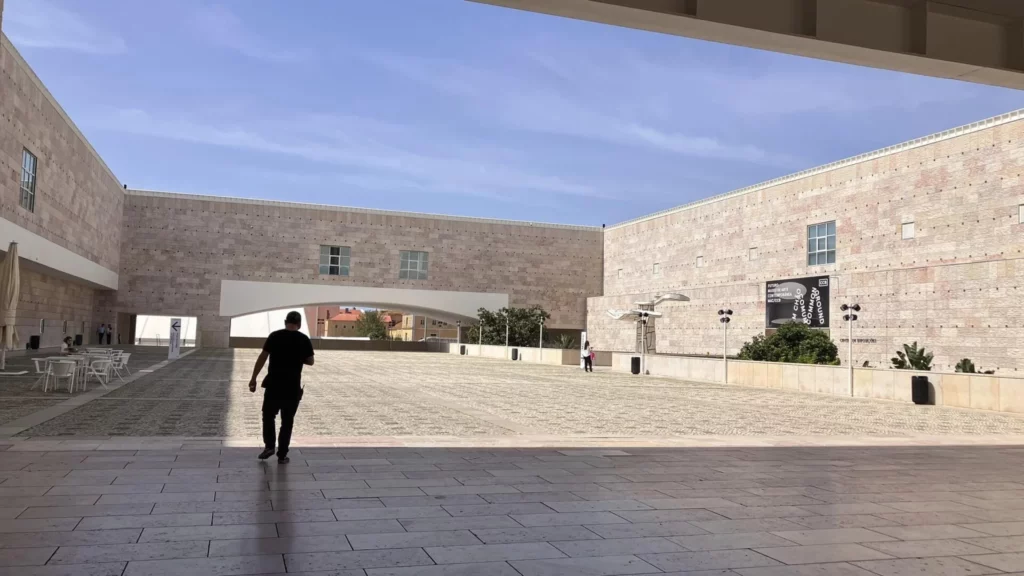
Belém Cultural Centre (CCB)

After this time-consuming exhibition, I had just enough time to go through the Jerónimo monastery and walk the church. The body of the famous poet Fernando Pessoa was buried in the monastery 50 years after his death. And the grave of Vasco da Gama, who discovered the shipping route to India in 1498, has been in the church since 1894.

These visits tired me a bit and when I walked back to the bus stop through a park, I followed the example of the many people lying on the grass and lay there for more than half an hour as well.

Back in Lisbon, on my way to a vegetarian restaurant, I found the bustling 'Time Out' market, a large hangar with numerous exquisite food stalls all around and long tables in the middle for eating socialising. It really seemed to be the place to be to be. In the centre of the room, some people were dancing. In one of the corners, participants of the 'Time Out Academia' were cooking an exotic dish. Nice concept: for 25€, participants are helped by a chef and his assistant to prepare their own dish.

Share this post on social media

Read more...

en_GB