
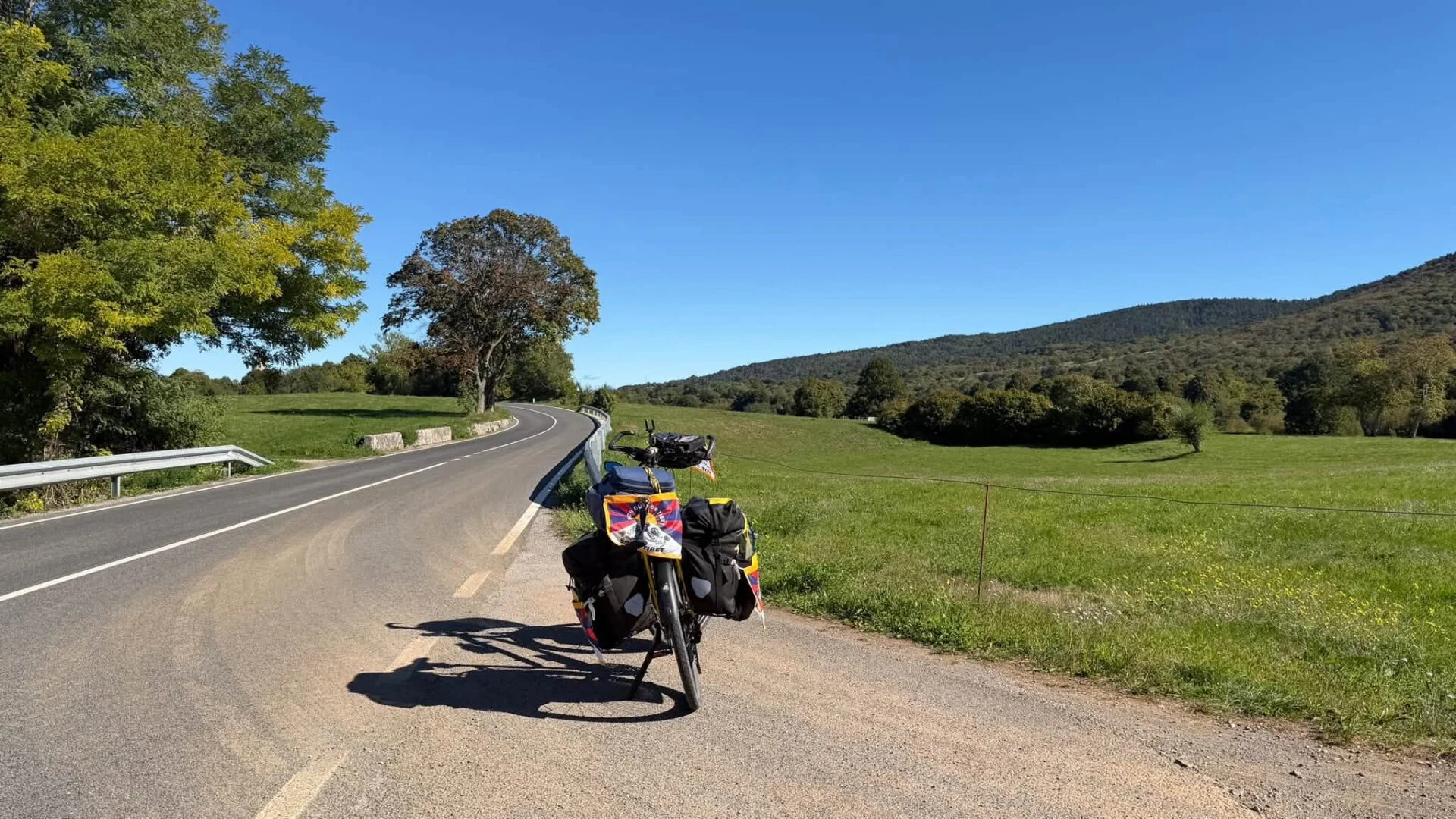
Around the Adriatic Sea 2026: Trieste – Dubrovnik
All photos: Balkan photos, city photos. The photos of the cycle route are listed in reverse chronological order. Those of the cities are listed chronologically.

14 March: Playa Taray in Huelva - Tavira (Portugal)(47.7 km - 330 D+)
I left the campsite around 10:30 and first went to a bike shop in Isla Cristina To get my brake pads replaced. Just after I entered the shop, a couple came in. They asked where I was from. They were also from the province of Antwerp, more specifically Sint-Antonius Zoersel, where my friend Els Van Vlimmeren also lives. They have two dogs and know Els well because they walk their dogs in the same forest. What a coincidence to meet in a tiny bike shop more than 2,000 km from home!
After Isla Cristina I cycled via the Via verde litoral to Ayamonte, through vast 'salinas' (salt fields). In Ayamonte, I had to take a ferry to cross the river Guadiana, which forms the border with Portugal.
The ferry docked at the Portuguese coastal town Villa Real de Santo Antonio. I continued along the Eurovelo coastal route through vast dunes and pine forests. What immediately struck me was the absence of litter along the cycle path. In Spain, you see litter everywhere, sometimes even along footpaths in natural areas such as the Doñana Park. The Portuguese seem to be more environmentally friendly.
Another positive difference I have noticed is that in taverns or bars, they are less loud and noisy than the Spaniards. A real relief.
Around 17:30 I arrived at the Pousada de Juventude from Tavira, where the staff were extremely helpful and friendly.
This was only my very first day in Portugal. Let's hope the pleasant atmosphere stays that way.
March 15: Tavira - Santa Barbara de Nexe (33 km -370D+)
Margareta and Etienne, a couple from Antwerp who moved to the Algarve last year, had invited me to their home in Santa Barbara de Nexe, a small village about 30 km from Tavira. They expected me around 5pm, so in the morning I had time to go through Tavira stroll.
I walked through the well-kept botanical garden of the old church of São Francisco. The church itself was closed. I then climbed the stairs up to the castle, of which really only a few fortified walls remain, surrounding a cosy garden.

Next to the castle, I saw the main church of Santa Maria do Castelo, which was founded in the 13th century on the site of a former mosque. It was rebuilt in the 18th century after it was severely damaged in the 1755 Lisbon earthquake. At this time, a group of people were restoring some statues and artworks, including a huge painting of the Last Supper. The main altar is one of the few examples in Portugal of the trompe l'oeil painting technique.
I only took a few photos, including one of St Anthony, who was also so often seen in French churches.
The Roman bridge and the old centre of Tavira with its many colourful backstreets were also nice sights.
After a light lunch, I collected my bike from the youth hostel and left for Santa Barbara.

March 18: Santa Barbara de Nexe - Armação de Pêra (47 km - 430D+)
Saturday around 11am, after saying goodbye to Margareta and Etienne, I left Casa Allegre.
The first kilometres went smoothly on small provincial roads, but suddenly the road turned into a very bad dirt road with big stones and deep grooves that climbed steeply up to a railway track. With my fully packed bike, I could not cycle up that dirt road unless I took my luggage off my bike, carried it up first and then the bike.
Before I started on that, I went on foot to see how long the dirt road was. It ran along the track as far as I could see. Therefore, I decided not to follow Komoot and look for an alternative route.
However, this was not evident.
At an intersection, I could not turn right because the road I had to take was under tunnel. I had to diversions via shortcuts, but there my route was suddenly interrupted by the railway. There was a small crossing over the tracks for pedestrians, but it was too difficult with a heavy packed bike. Fortunately, a boy helped me hoist the bike over the tracks.
Eventually I got back on the main road and from there I encountered no more problems until the Camping Canelas at Armação de Pêra.
March 19: Armação de Pêra - Lagos (44 km - 380D+)
On the beach of Armação would be fishing huts. Since I was on Camping Canelas could still stay until 7pm, I decided to cycle to the beach before taking down my tent.
However, I did not notice the huts among all the tourist infrastructure on the beach.

On the chimneys of a factory next to the busy N3 I saw many storks' nests. These birds are apparently not looking for romantic nesting sites....
At Azambuja, a city that is not exactly in a very attractive hiking area, I saw several backpackers. A little further on, I saw the explanation of their presence: a sign from the Camino de Santiago.
Beyond Azambuja I was able to leave the N3 and follow a quiet local road along a railway. Finally the kind of roads every cyclist longs for!
Around 1pm, I left for Lagos. The first part of the route I followed a tiny, provincial road with very steep inclines.
Once past the village Porches I had had enough of the tough climbing and followed the N125 for about 20 km, saving a lot of time. Taking that road allowed me to cross the wide river via two bridges Arade full of swamps, which surrounded the Komoot route through the city Portimão.
Beyond Portimão, I again followed the more difficult provincial roads as far as Lagos.
20 March: work/rest day in Lagos
This morning I created the layout of the next Reach Out newsletter, which will be sent to Dutch-speaking readers on Tuesday afternoon. The English version will follow.
Those wishing to receive them can register on the website www.reachoutforacause.org.
In the afternoon, I went hiking on the rugged cliffs south of Lagos. The ocean has an impressive coastline formed by 50-metre-high cliffs of limestone from the Miocene.

On returning to the city, I saw a street artwork by Daan Botlek, a name that sounded familiar to me. He is an artist from Rotterdam (www.daanbotlek.com)

March 21: Lagos - Vila do Bispo (27.5 km - 420D+)
I had planned to go to Sagres to go, a village in the far south-west of Portugal. But two slopes of 20% put me in Vila do Bispo stopped, 10 km north of Sagres. If I cycled south to Sagres, I had to cycle back along the same road the next day.
I followed Eurovelo 1 and contrary to Eurovelo's claim that all routes are feasible for any average cyclist, those two steep climbs of 20%, just before and after the village were Salema, impossible to cycle up. Even pushing my bike up those hills was too hard. I had to stop and rest every 20 metres.
After the second killer bike slopes of Salema to Figuera I was close to the N-125 and signed off for Eurovelo 1. The slopes of the N-125 have always been achievable for me so far. That was the case again now, what a true bicycle ventilation was after cycling at Eurovelo.
Cycling is difficult here, but as the photos show, the landscape is greener and more beautiful than in eastern Portugal. It reminds me a bit of Ireland.
Tomorrow I will stay on the N roads and hopefully move forward a bit faster.
March 22: Vila do Bispo - Odeceixe (52 km - 550D+)
Hooray! Today I finally had a bike ride without having to push my bike uphill! The first 15 km to Carrapateira over the quiet, gently undulating N268 were very comfortable. The scenery on that stretch was fantastic: green hills with lots of flowers, Mediterranean pine trees and occasional ocean views.
At Carrapateira I was sitting on a bench eating an apple when Chris from Wales passed me with a yellow bike that looked like the male counterpart of my bike, including the yellow panniers. Such a coincidence deserved a photo!
After the next village Bordeira came a long climb followed by a gentle 10km descent to Aljezur, where I went to eat a soup on a terrace. I had parked my bike against a bench in a small park across from the terrace. Although many other benches were vacant, a man sat down right next to the luggage on my bike. He made me suspicious. I was afraid he would wait until I went inside to make his move. As a precaution, I moved my bike before going to the toilet. When I returned, the man was still sitting on the bench, so I guess my suspicion was unfounded. My apologies.
From Aljezur to Odeceixe I followed the N-120. The landscape here was more monotonous. First a 20-minute climb and then 12 km over a plateau followed by a fairly steep descent to Odeceixe.
Despite some headwinds, a pleasant day of cycling.

March 23: Odeceixe - Porto Covo (57.5 km - 510D+)
How many coincidences can there be? Who came biking up the hill when I was about to go camping São Miguel leave? Right, Chris the Welshman with his yellow bike!
Again, it was a smooth cycling day today with no dismounting to push my bike uphill. The first 20 km were a bit difficult with some long climbs, but then the road became very flat with the occasional gentle incline. Pedalling took much less effort today, I was moving forward quite fast.
Around noon, the sun was veiled by high clouds. Towards evening, some dark clouds piled up, but it remained dry. The landscape was still very green. As in southern Spain, I saw numerous storks today. Along the M502, there is a stork's nest on almost every power pylon.
The view from the bridge over the river Mira at Vila Nova de Milfontes was great.
Around 16:30 I arrived at the campsite of Porto Covo, early enough to go for a walk in the village and on the beach. I thought there would be a sandy beach and had brought a towel to do some yoga exercises, but the coast here is rocky and the sea was quite wild, with waves 3 metres high. Impressive.
Porto Covo is a quiet village, unlike the very busy Spanish coastal towns.

March 24: Porto Covo - Lagoa de Santo André (44.1 km - 330D+)
Today I had planned a shorter ride because between Porto Covo and Lisbon is only one campsite. So I didn't rush this morning and had a nice conversation with Mark, an Irish cyclist who is on a year-long cycling trip. He passed by the road I am currently taking to head north, so he was able to give me a lot of useful information.
Up to Sines it was a beautiful route along the Atlantic coast. Although the road was flat, I progressed very slowly as I stopped at almost every parking space to look at the ocean and its swirling waves. Beautiful seascapes along this road!
Beyond Sines I followed a parallel road along the motorway through a vast pine forest. The landscape reminded me of the Landes at France.
Before I had the Camping Lagoa de Santo André reached, which is on the shore of a large lagoon, I had to take a 2-km dirt track that was too sandy for my bike. So I ended my trip with a 2-km walk-bike ride. After pitching my tent, I witnessed a beautiful sunset over the lagoon.
Today I went over the 4000km mark.
How much more to go until Antwerp, Belgium?
25 March: Lagoa de San Andrés-Setubal
I had perfectly avoided the 2 km walk-bike-sand road yesterday. Only a few hundred metres further on was a paved parallel road. The GPS, GoogleMaps this time, fooled me again by sending me via a hiking GR.
Anyway, this morning I was able to start cycling immediately without having to step out first. About 40 km via a straight, slightly undulating quiet road through a vast forest. A monotonous road with little visual input. It was Zen cycling.
The last 9 km to the ferry across the mouth of the Sado to Setúbal went along a narrow strip of land with the Atlantic Ocean on the left and the Sado estuary on the right. The ferry costs €5.60 and takes 25 minutes. So the last 6 km of this ride I cheated.
Halfway through the boat trip, we could see dolphins, but only their dorsal fins rose above the water.

March 26: Setúbal - Lisbon (43.3km - 370d+):
Last night after dinner, I strolled around the old city centre of Setúbal and took a photo of the beautiful church Santa María da Graça.
To go today Sunday to Lisbon to go, I first had to cross a hill and then take a ferry that crossed the Tagus crossing. Several routes were possible. Cristina, the receptionist at the Dayoff hostel where I was staying for the night, advised me to cross the Tagus via Montijo. This route involves a relatively clement 250-metre climb to Palmela and then mainly downhill via Pinhal Novo to the ferry in Montijo.
As expected in a suburban area, it was a busy route with a lot of traffic, but Portuguese drivers were polite on this route and left plenty of space when passing by.
At Pinhal Novo I drank a coffee and checked the route again. Komoot went straight to the ferry in Montijo to the Tagus cross over to Lisbon, but according to GoogleMaps, there was no ferry at all in Montijo! GoogleMaps sent me all the way back to Almada, a diversion of 44 km. To be sure, I double-checked with the waitress and two other customers in the café. These confirmed that a ferry did leave from Montijo. Not too sure if it was the right decision, I set off for the last 9 km to Montijo. Fortunately, there was an excellent cycle path next to the N252!
The ferry terminal was a few kilometres beyond the town and I asked some pedestrians again if there was a ferry. They confirmed that there was, but said the ferries were on strike today! I checked on the internet but saw no warnings about a strike and continued to the terminal. I was lucky: the ferry left as scheduled at 4pm. Much ado about nothing....
Probably the confusion with GoogleMaps is due to the fact that it is a pedestrian shuttle, but to my great relief, bicycles were allowed. A ticket costs just €3.5 and the journey takes 25 minutes.
When I got off the shuttle in Cais Do Sodré, right in Lisbon's city centre, I was a little overwhelmed by the crowds of people lining the quays of the Tagus strolled. The crowds made it impossible to cycle; I had to walk all the way to the hostel I had booked.
All photos: Balkan photos, city photos. The photos of the cycle route are listed in reverse chronological order. Those of the cities are listed chronologically.
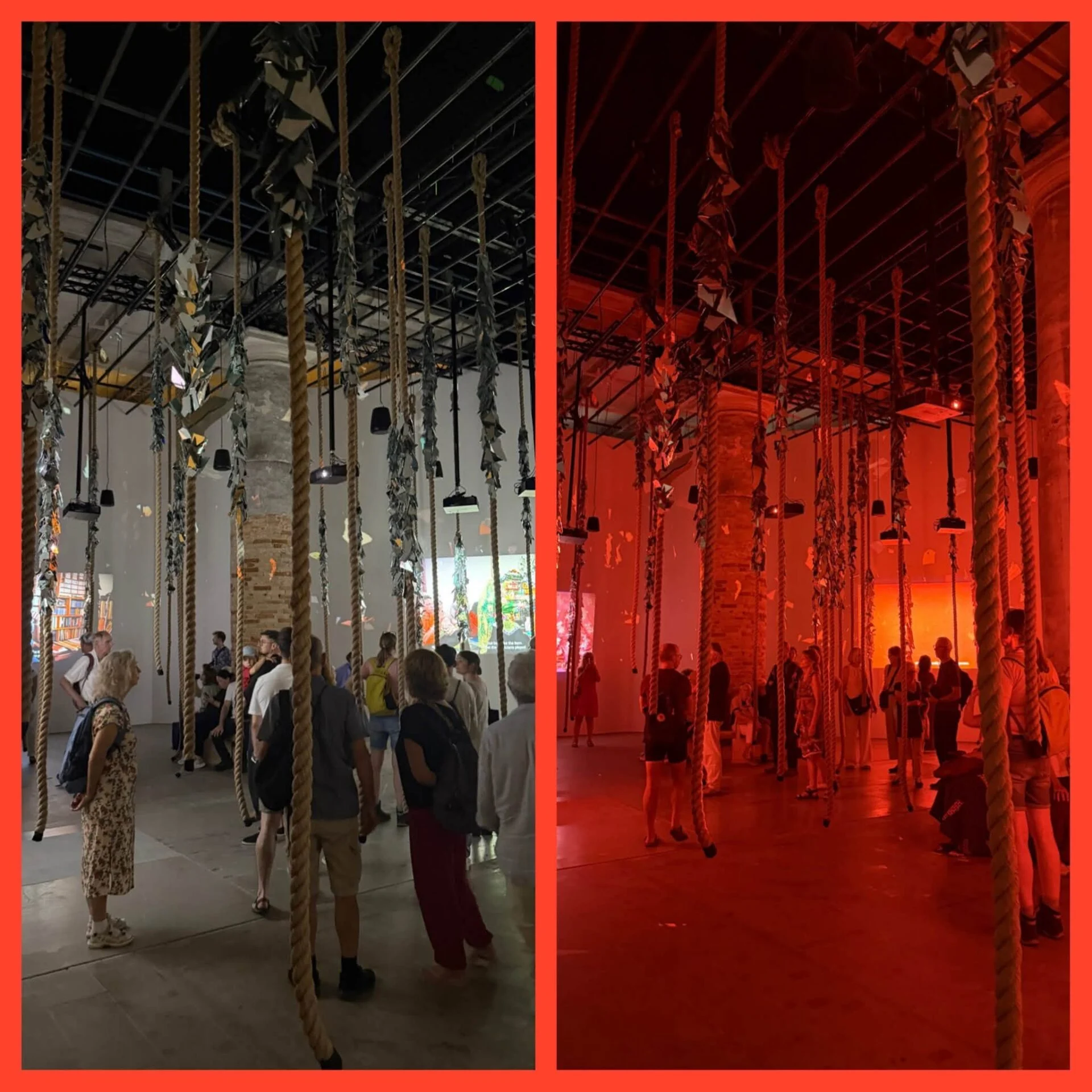
In Venice, I visited the Biennale at the Arsenale, the Giardini and various venues around the city. I also took the opportunity to see the Pinault collection at Punta della Dogana and a compelling exhibition by Michael Armitage at Palazzo Grassi.


