
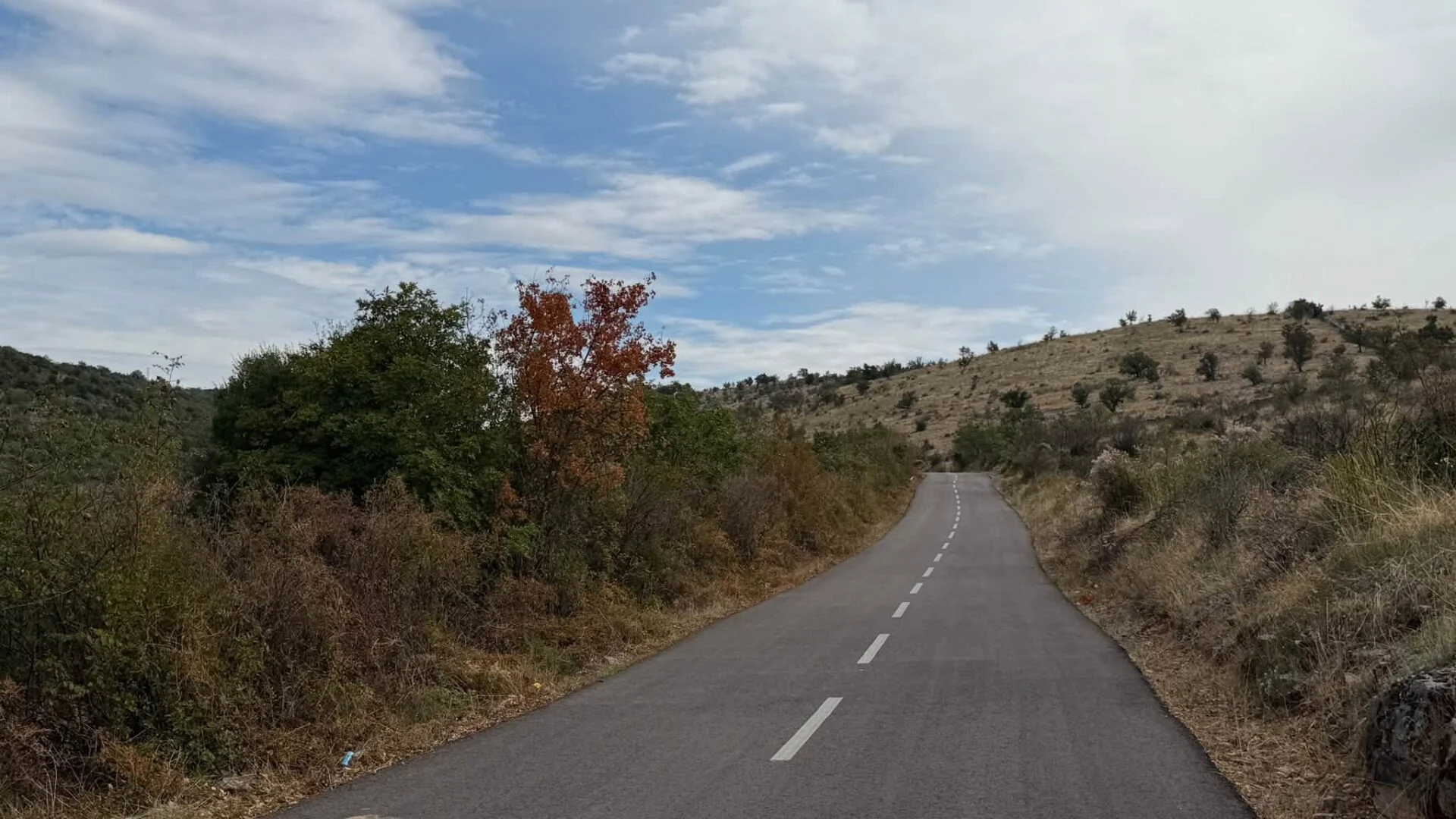
Around the Adriatic Sea 2026: Dubrovnik – Durrës (Albania) – Bari
The second leg of my cycle tour around the Adriatic Sea: the Balkan countries, probably as far as Dubrovnik in Croatia, perhaps even further…

The crossing by ferry went happily for me this time without a barf bag, although some less fortunate fellow passengers did get seasick when we were in high seas.
Retrieved from Barra, the southernmost inhabited islet of the Western Hebrides, was a small supermarket where I could stock up on provisions for a few days. At Borve campsite although the campsite was actually full, the welcome was very warm. My stay was free and I shared a spot with a fellow camper Theresa. Moreover, a beautiful sunset fell to me there.
It was a jacket fresher on the Hebrides than in Oban, though. I had to put on my down jacket again in the evening.

Coast on Barra island
My first cycling kilometres on the Hebrides were straight away eye-catching and body-friendly: nail-white beaches, a picturesque harbour, vast 'zen' plains and - importantly for a packed cyclist - no overly steep hills.
The fish cages in one of the photos are used to catch lobsters and crabs. Fishermen leave the cages on the seabed for about three days and then pull them back up.
On the way, I saw an arrow pointing to 'Barra airport'. Earlier, I had read - and remembered - somewhere that the planes landing there on the beach. That was worth a diversion! I was lucky: the windbags had been hoisted, indicating that a plane is about to land and one is not allowed to enter the beach. Security for everything!
I positioned myself on a dune and waited for a while. First, a jeep driving back and forth across the beach, moments later it came Glasgow passenger jet to it and it indeed landed on the beach.
I shot a short video of that landing.
After the ferry crossing to South Uist island awaited me a steep climb out of the harbour. Less fun was that it started to drizzle and I would arrive at the campsite in the wet. On the way, I saw a sheep that sought shelter in a bus shelter
It turned out to be a rainy Sunday - yet another in a sorry series. Therefore, I decided not to cycle. Unfortunately, the camping tavern was closed because the owners were attending a wedding party - fun above money, big time. This left me without wifi and with a very weak mobile data connection. By necessity, it also became a digital rest day.
It's great cycling on these two islands of the Western Hebrides! A vast plain dotted with small to larger lakes and a few here and there isolated homes, bordered on the western side by the ocean and magnificent beaches, and on the east side by a (dark) green row of hills.
There are also many ruins and in the fields you sometimes see a high standing stone or overgrown cairns (cairns) of burial mounds.
In the Kilondan museum I read that emigration from here was mainly towards Canada. That probably explains, as in Ireland, the presence of the multiple housing ruins.
To get to Benbecula island I had to cross two elevated causeways connecting the islands.

Ferry to Eriskay
It's great cycling on these two islands of the Western Hebrides! A vast plain dotted with small to larger lakes and a few here and there isolated homes, bordered on the western side by the ocean and magnificent beaches, and on the east side by a (dark) green row of hills.
There are also many ruins and in the fields you sometimes see a high standing stone or overgrown cairns (cairns) of burial mounds.
In the Kilondan museum I read that emigration from here was mainly towards Canada. That probably explains, as in Ireland by the way, the presence of the numerous house ruins.
To get to Benbecula Island I had to cross two elevated causeways connecting the islands.
July 30: Linaclate - Balranald/North Uistle Isle (62 km -164 m climb)
Beautiful ride through wide landscapes. The elevated causeways after Benbecula airport - with asphalt tarmac this time - were overwhelmingly beautiful. I barely make progress here because I am always gawking open-mouthed at the scenery. The roads with often only one lane also force you to stop frequently at 'passing places' to let cars through. Relaxation prevails on the Hebrides.
On North Uist I passed the ruins of 'Teampall na Trianaid' (Trinity Temple), a medieval monastery and 'learning centre'. The Irish philosopher John Scotus Eriugena (9th century), who opposed Roman Catholic theīsm with a Neoplatonic-inspired panentheistic view of God, is said to have studied there.
From my tent on Balranald campsite I look out on a hill with a graveyard. In the field in front of it, a great brown owl was hunting in the evening. Good to follow with binoculars, but too fast and far away to photograph. Just behind the campsite, behind a dune, is a bay with a sweeping beach. During a blissful evening walk, I saw a beautiful sunset which, as usual, cannot be captured in a photo. On top of the dune I had mobile reception again for a while, my phone suddenly started pulling in all the notifications and emails. The Hebridean way of working: Reading e-mails on a dune overlooking the sea 😊.

North Uist, beach at Balranald campsite
At 6am, I had to get out of the tent for a pee. Early enough to see the mysterious orange mists in the morning landscape on the sensitive digital record.
And again it became a trip through blood-curdlingly beautiful landscapes. The Scolpaig Tower, in the middle of a loch of the same name, dates from the 19th century. In 1830, one Alexander MacLeod the loch dry to make a Gregorian-style tower building on the islet. Just a rich man's folly, apparently.

Scolpaig Tower, North Uist
The landscape on Isle of South Harris is back more dramatic with higher hills and large rocky outcrops. Near the hamlet of After Bothain I saw a fairly large standing stone in a meadow. It would have been planted there 5,000 years ago, surrounded by a stone circle with some 30 megaliths. These have now disappeared, but some of the stone bases into which the megaliths fitted were still visible.
My tent Is in an unsupervised campsite overlooking the sea. Tonight, sleep peacefully to the beat of the waves.
This morning I first walked to a giant standing stone near the campsite I had noticed from the roadway in a meadow yesterday. To do this, I had to cross a grassy hill with beautiful views of the islands and pale yellow beaches.
I estimate the monolith was about 3 metres high. With my 1m72, I stood in front of it with my arms raised and it reaches about another metre higher. In the picture, I am not wearing a terror cap, but a main net against bitey midgets which unfortunately were there in large numbers. There was virtually no wind today, and then they circle around your head in clouds, biting where they can, crawling into your ears and nostrils.... Tiny spiteful little pests they are. It was so quiet and peaceful there by the stone, all alone and with that wide view. Despite the midgets, there was quite a while I just kept sitting quietly on a flat rock in front of the stone, to get a good sense of the special energy there.

Monolith at Horgabost campsite (with anti-midget head net)
As a result, I was back on the bike quite late. The journey to Tarbert first followed the banks of a vast lagoon, and then went long uphill a hillside about. Sometimes I imagined myself on the moon, so barren and rocky was it there.
At Tarbert was a bed free in a Backpackers Hostel. Although it was only half past four, I decided to stay there and do another big wash. For the dryer it was a bit of a queue, so I had to go in just my swimsuit with the down jacket over it to the local supermarket, which was soon to close. All my clothes were in the wash.... But no cat said anything or looked weird.
From Tarbert, the ferry leaves for Uig/Isle of Skye, but I will - hopefully - keep that big island for another time.
Tarbert is a cool village, actually but one 'main street' great, with a marina and ferry terminal to Isle of Skye. There was a fish and chips stall with fresh fish. As it was getting close to lunchtime by the time I wanted to drive on, I first consumed a portion there to take my mind off the long and quite steep climb ahead.
I left next to a long fjord, bordered on the opposite side by green hills. A landscape with a high Norwegian content.
This was followed by the long and quite tough climb over the ridge. I did not have to push this time, but did stop about three times to de-acidify my leg muscles. After that, I was able to climb quite a bit each time. It's weird, first you ride up next to a fjord on sea level, and an hour later you find yourself in a high mountains with babbling brooks and all, at barely 200m altitude.
On this route to the famous Callanish stone circle is not located any campsite or hostel, so I had to wild camping. Finding a good spot was not easy, along the track there were over fenced meadows with cows or sheep, and more in the back I immediately ended up on damp peaty ground. I asked one John Angus who had just sheared sheep in his forecourt, whether he knew a suitable spot. He sent me 200 metres back to the Island's Book Trust. I had just passed there to go to the (public) toilet to go - with even a hot shower for 1£ - but on the car park behind the little building I didn't dare pitch my tent just like that. That wouldn't be a problem, John said, he knew the neighbours. We had another long chat - his sister had died last month - and I photographed him with his two dogs, who help him herd sheep.
As I was setting up my tent behind the Book Trust, I saw the neighbour and she confirmed that I was indeed welcome to camp there. Soon after, a young truck driver came by and asked me if there was a toilet. I pointed out the right door to him and he replied, "Haha, I've driven past this place hundreds of times, and now a tourist is showing me the way to the toilet. Have a nice holiday". Blessed people here, in Flanders I would have been chased away 20 times already.
The only drawback of this camp spot: behind the building I was out of the wind and it swarmed with midgets again. Unfortunately, it therefore became an indoor supper.

North Harris: climb from fjord to pass
Wonderful sunny weather today, fortunately with a breeze so the midgets don't fly out. With winds from 5 km/hour or more, they stay in their pens, wherever that may be... The route started on a dead straight gently sloping road through a marshy peat plain, with views of the Harris hills on the left in the distance.
In the hamlet Achmore I saw an arrow pointing to a stone circle that was not on the map or GoogleMaps, so to add to my collection of 'megaliths and stone mounds along the way' to complete, I walked towards it through a soggy patch of heathland.
It was a circle that discovered during peat extraction. It had become completely covered in peat over the centuries. Unfortunately, only half a stump was left standing, the other megaliths lying overturned beside their pedestals or having disappeared. From that stone circle, and only from there, you can discern in the skyline of the hills opposite the profile of a reclining pregnant woman. Unfortunately, I could not capture this in photo due to too small zoom range, but it is thought that this could be related to the location of this circle. The reclining woman here becomes 'The Old Woman of the Moors' named - well weird that it got pregnant then - either 'Sleeping Beauty' or 'Earth Mother'.
The Callanish Stone Circle about ten kilometres away is overwhelming. There is not only the circle with the remains of a tomb in the middle, but also four 'lanes' to it, in the shape of a cross and bordered by megaliths, some up to 3m high.
I found the atmosphere there less intense than previous stone circles and monoliths, despite this grandeur. Perhaps because there were more running and visitors were, but it could also be that he was too big for me. Comparable to the atmosphere in a gaudy cathedral, where the footsteps sound so hollow, or that in a small cosy Romanesque church in the countryside. I prefer the latter to unwind...
Approximately 1 km as the crow flies from Callanish I are two more smaller stone circles, Callanish II and III. There did reign the peace and energy I love so much.
In the last 20km to Shawbost campsite were some tough hills with a strong headwind. I was really happy when I arrived. At Shawbost campsite, I met David and Sue again, a British cycling couple I had already encountered at two previous Hebrides campsites. They rented a motorhome this year to do day cycling trips, as Sue occasionally suffers with her knee and doesn't dare a long bike ride. The cup of milk tea they offered me was very welcome as I found that I was a bit 'empty'. As long as you are busy, you don't feel that way, but as soon as you stop...

Callanish Stone Circle I
The islands Lewis and Harris its Calvinist and they would be the last bastion in Britain that still had the weekly Sabbath maintained. Everything, including tourist attractions, are closed on Sundays. The campsite even has a request not to hang laundry on Sundays. So a day to give the legs some rest and update English translations of my blog entries.
In the camp kitchen This morning I had a short conversation about my bike ride, the strict Sabbath and the fact that then everything was really closed with an English lady ready to leave. She was happy to give me some bread and food if I did not arrive. After all, since Tarbert the day before yesterday, I was not encountered any more grocery shops on my route. I replied to her that I could continue until tomorrow.
When I got back to my tent, in the porch stood a gift bag with some treats and the text 'Wish you a good continuation of your trip'. Isn't that amazing? I don't even know her name...
I found that attention so warm-hearted that I briefly overflowing with thanks, which resulted in moist little eyes and a very warm disposition. Life (together) can be oh so simply beautiful!
Thanks a lot, lovely lady!
A trip with two sights and 30 km 'through blissful emptiness' to Stornoway.
After a night of heavy rain, fortunately it dried up a bit in the morning and I was able to leave by noon.
Since I only had a good 40 km to drive to Stornoway, where I take the ferry to Ullapool tomorrow afternoon, I had time to do some sightseeing along the way.
The first stop was the Norske Mill & Kiln, with in the first building a mill with a horizontal grinding stone driven by water along the bottom, and in the second a boiler room with a deep hearth around which the grain was first dried.
On the continuation of my route, it started pouring, so I arrived soaking wet at my second destination, a museum village with 'black houses. These were oblong houses with stone walls and straw roofs in which livestock and residents under the same roof lived. Some had no chimney; the smoke from the fireplace left the house through the roof, which turned black as a result. Hence the name 'black houses'. For those interested: you can stay overnight in one of the restored cottages.
I stayed there longer than planned because the rain just wouldn't stop and attended a demonstration by a handloom with which the famous checked tweed fabrics were woven.
By 5 o'clock the rain eased a little and I left for a 30 km ride through a lovely vast empty landscape. There were not even sheep. However, there are still peat stabbed. First, the turf carefully trimmed and laid aside, then over a depth of approx. 60 cm of peat cut and laid in small piles to dry for a few days. Afterwards, the turf is neatly laid back in the cut, so that the landscape remains nice and green. You can only see the level differences between the lowered strips where peat was cut, and the higher areas.
So far, this has been the finest ride of my entire trip. In this landscape, your mind comes to a complete rest. Pure cycling meditation. I was actually sorry when I saw on a signpost that it was only 7 kilometres to Stornoway.
Just before I arrived in Stornoway, the bike emergency struck again: again my chain came off while shifting down, the third time in three days. So the next morning I decided to pass by a bike shop first thing, because in the highlands I will often have to change to the smallest blade while climbing in front.
At Stornoway hostel I had a conversation with soprano Barbara Scott, who was staying in Stornoway for a gig. She apparently does not consider herself a diva, given her stay in a simple hostel with bunk beds. Barbara was looking forward to Scotland leaving the EU. So far, I have not met a single Scot who wants this. I'm curious to see what's in store; I have the impression that those in favour of independence, who want to cut ties with the UK, enjoy a lot of support. This could become a complicated issue here.

Lewis, from Carloway to Stornoway
Today it was bicycle repair day and ferry crossing from Stornoway to Ullapool. Both succeeded: after a visit to Bespoke Cycles in Stornoway, my chain no longer slips off when 'climbing gears' - tested several times uphill - and I now find myself back on the mainland in Ullapool, with a weather forecast of several days of wetness ahead. But it would only be 'light rain', last week saw much heavier weather here and in the rest of the UK, resulting in several floods. That I was able to avoid those on the Hebrides is already some consolation.

Stornoway
Now on to John O'Groats, the northernmost point on the mainland, and then diving down to Kingstone-upon-Hull. I did a quick count, over 1,250 km left to pedal in 24 days. That's an average of 52 km a day. I should be able to do that, but then again I shouldn't detour or drift too much.
For the mileage sponsors: I got the cape of 3,000 km exceeded by 50 km. So I should end up with a total of somewhere around 4,300 km.
The second leg of my cycle tour around the Adriatic Sea: the Balkan countries, probably as far as Dubrovnik in Croatia, perhaps even further…
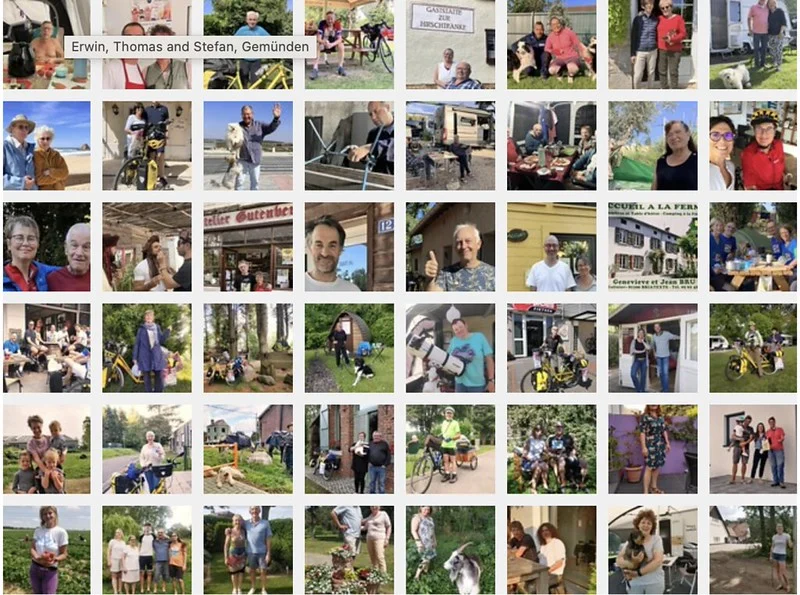
On my travels, I meet so many friendly, helpful and hospitable people.
They deserve a hall of fame.


