

Hundreds of Buddhist monasteries were demolished. The remaining monasteries are under the strict control of the Chinese Communist Party (CCP). The monks who still live there serve merely as ‘museum pieces’ for tourists. They are not allowed to speak… Possession of photographs or texts relating to the Dalai Lama is punishable by imprisonment. The traditional multicoloured prayer flags are banned. In 1995, China abducted the six-year-old boy Gedhun Choekyi Nyima, who had been designated as the 11th Panchen Lama by the Dalai Lama just a few days earlier. The Panchen Lama is the second-highest religious leader after the Dalai Lama. The Chinese subsequently appointed a Panchen Lama loyal to the authorities, who, however, enjoys hardly any support in Tibet.

All teaching of and in the Tibetan language is banned, even home tuition by a private tutor. Anyone who dares to teach Tibetan runs the risk of ending up in prison.
The Chinese have already forcibly separated a million Tibetan children from their parents and sent them to remote Chinese boarding schools where they are taught Mandarin. As a result, these children become completely estranged from their families, language and culture.
A culture exists by virtue of its language. The destruction of a language automatically leads to a loss of identity and the destruction of a culture.
As a result of a policy of mass immigration of Han Chinese, the Tibetans have now become a discriminated-against minority in their own country.

Sophisticated cameras, including those with facial recognition, are installed everywhere to monitor the comings and goings of Tibetans. Social media and communication platforms are strictly censored, and access to Western platforms is blocked. Telephones are tapped, which prevents exiles from having an open conversation with their family members still living in Tibet. A culture of informants is encouraged and rewarded, even within families. Tibetans can no longer trust anyone, nor do they dare to (Photo: Jpatokal - Own work, CC BY-SA 4.0)
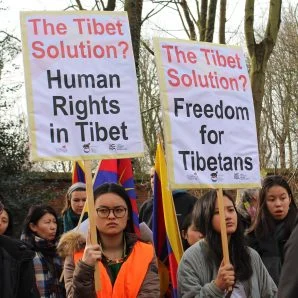
Staff at Chinese diplomatic missions keep a close eye on Tibetans living in exile. If they take part in protests, this can have serious consequences for their family members in China. A recent law that came into force on 1 July 2026 provides the authorities with a legal basis for transnational repression. The title of this 'Law on Ethnic Unity and Progress' sounds unifying and progressive, but in practice it is a law that can enforce ideological conformity and ethnic unity. Article 63, for example, provides the Chinese authorities with a pretext to take action against people outside China for any act which, according to the Communist Party, "undermines ethnic unity". As a result, supporters of Tibet, dissidents and critics abroad are at risk.


