25 July: Spanish Toll House. Once again those Spanish...
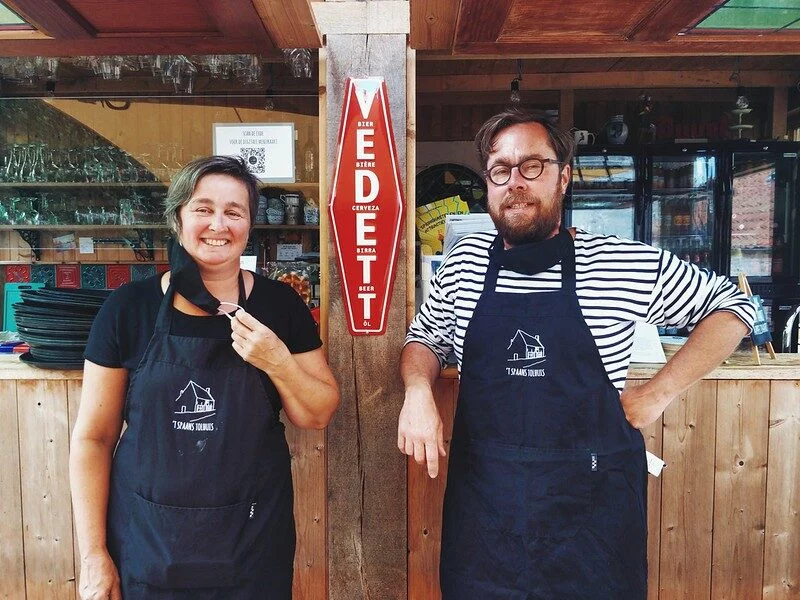
On Saturday afternoon I passed next to the Bruges-Ostend Canal past a listed dilapidated building that was once aSpanish Tollhouse had been. The garden now housed a cycling and walking café: 't Spaans Tolhuis.
Having also encountered the Spaniards repeatedly in De Klinge and Kemzeke, I decided to go there for a Latte Macchiato.
When I had fulfilled the corona obligations upon entering, I gave a flyer about my walking project for Street Nurses vzw. I was pleasantly surprised when it turned out that Peter, the new young operator, works for the Youth Welfare Agency West Flanders. He deals with the prevention of homelessness of young people and young adults and, like Straatverplegers, puts the 'housing first' principle first. He was immediately able to provide information on the presence of homeless people in Ostend.
I learned from Peter and Joke, his partner, the enthusiastic operators who plan to restore the tollbooth in about three years' time, that the history of it is summarised on their website. That saves me a lot of typing:
"The tiny Spanish Toll House along the towpath from Plassendale to Bruges was once the gateway to a sturdy 17th-century fort. This guarded the old lock at Plassendale. Guardhouse for Spanish soldiers; commander's residence; toll office; inn; house of the lockmasters; a last port of call for old bargees and ice-land sailor "Berten": the little monument on the waterfront has a lot to tell you."
"Four hundred years of locks, forts, cannon roar, shipping, residents and their stories are given a place by the water".
For those interested in a chronological overview, that can be found below:
A funny anecdote Peter still told me is the story of the nickname of Spain's Isabella 'grey' (Isabella of Spain and Albrecht of Austria, countess and count of Flanders from 1598 to 1621): she had sworn in not to change underwear until the Geuzen city of Ostend would be handed over to the Spanish. That did not happen until 1604! Poor Albrecht....