Compassion Rising Tour 2025: Kaunas - Arts and Culture

August 24: Kaunas - Ciurlionis museum

Ciurlionis (1875-1911), musician and visual artist, is one of Lithuania's most important artists. An entire museum in Kaunas is dedicated to his work. This year, his 150th birthday will be celebrated with a special exhibition, "From Amber to the Stars with M.K. Čiurlionis". Indeed, the sea and the cosmos were his favourite themes.
The exhibition features work by Ciurlionis, his contemporaries and contemporary artists around those themes. See notes below some of the photos.
There is also a permanent exhibition of Ciurlionis ' work, which I had to rush through due to lack of time.
Ditto for the second floor with folk art from the 14th to 20th centuries).

Ciurlionis: Friendship (1906/07)

On the ground floor, a fascinating hall was dedicated to 'Lithuania, the land of crosses'.
Christianisation of Lithuania was reportedly difficult: Jesuits only succeeded in crystallising the country in the 17th century. After that, artistically designed crosses sprang up everywhere, in memory of the dead or as symbols of spiritual protection from all kinds of calamities.
During the Soviet occupation, professing religion was a form of dissidence.
Crosses were erected at dangerous places, at the beginning of a village or near houses. There, they were also a status symbol.
Indeed, I have come across many along the way.

'Lithuania, the land of crosses'

25 August: Kiemo Galerija (Yard Gallery)

Now this is an initiative that makes me happy and that I enjoy writing about!
 
The courtyard in question dates from between the two world wars. At the time, it was a place where the residents of the flats overlooking it did all sorts of things together. There was a long table, flowers were planted, fun was had, and in more difficult times, people helped and comforted each other.
 
With the arrival of the car, the courtyard deteriorated into a car park, where even rubbish was left behind.
 
Artist Vytenis Jakas wanted to remedy this and, with the help of other artists and residents, created the Yard Gallery.
 
The walls tell the stories of Jewish residents before the Holocaust (in which 90% of Lithuanian Jews were killed), of current residents, of dreams and desires....
The courtyard is now once again a community-forming place where people get creative.
 
Many of the works had a QR code with background information. I pasted these under the photos, which saved me a lot of typing 😜
I also see a parallel here with the previously doomed Flemish polder village Target: first a close-knit village community; then the threat of port expansion and driving out residents; degradation and now hopefully a resurgence again. I hope the village becomes a close-knit village community again, albeit with new residents, and that it is not abandoned to greedy developers.
 
A similar art initiative to commemorate the original inhabitants and tell the history of the village would be nice.

'Safe neighbourhood' - One of the many murals in the gallery

On Mondays, museums in Kaunas are closed. Therefore, after visiting Yard Gallery, I took a city walk. First eastwards via the 1.7km-long Laisvės boulevard to the gaudy, mega-sized Sobor - Archangel Michael church. That neo-byzantine building was erected from 1895 by Russian Tsar Alexander III as a garrison church, Sobor. In 1919 it became a Catholic church, under the Soviets it was a museum and after independence it became a church again.

When I arrived, the church was closed. It was already closing at 14:30.
Next to that church was the Mykolas Žilinskas Art Gallery. A contemporary 1989 building that was already in need of restoration. At the entrance of that building, Petras Mazūras' famous 1986 'Man' sculpture was placed.
An eye-catcher.
 
A little past this church was Kaunas' Tibet Square. As Robertas told me, it is just a small square with only a sign with the name of the square in Lithuanian and a signpost to Lhasa. But the fact that the city maintains the name 'Tibet' already means a lot, as China is not only trying to destroy Tibet's culture and language, it also wants to change its name to Xizang. Tibet must be completely forgotten...
 
I then walked along a parallel street towards the old town, which was located at the tip of the confluence of the Nemunas and Neris rivers, Lithuania's two largest rivers.
 
Along the way, I pulled up some interesting buildings or beautiful details that caught my eye. Kaunas is the city with the most modernist buildings from the interwar period. Many of these buildings were given an EU heritage label.
 
The weather was changeable with frequent heavy rain alternating with cautious sunshine. This unstable weather produced spectacular skies that were also worth photographing.
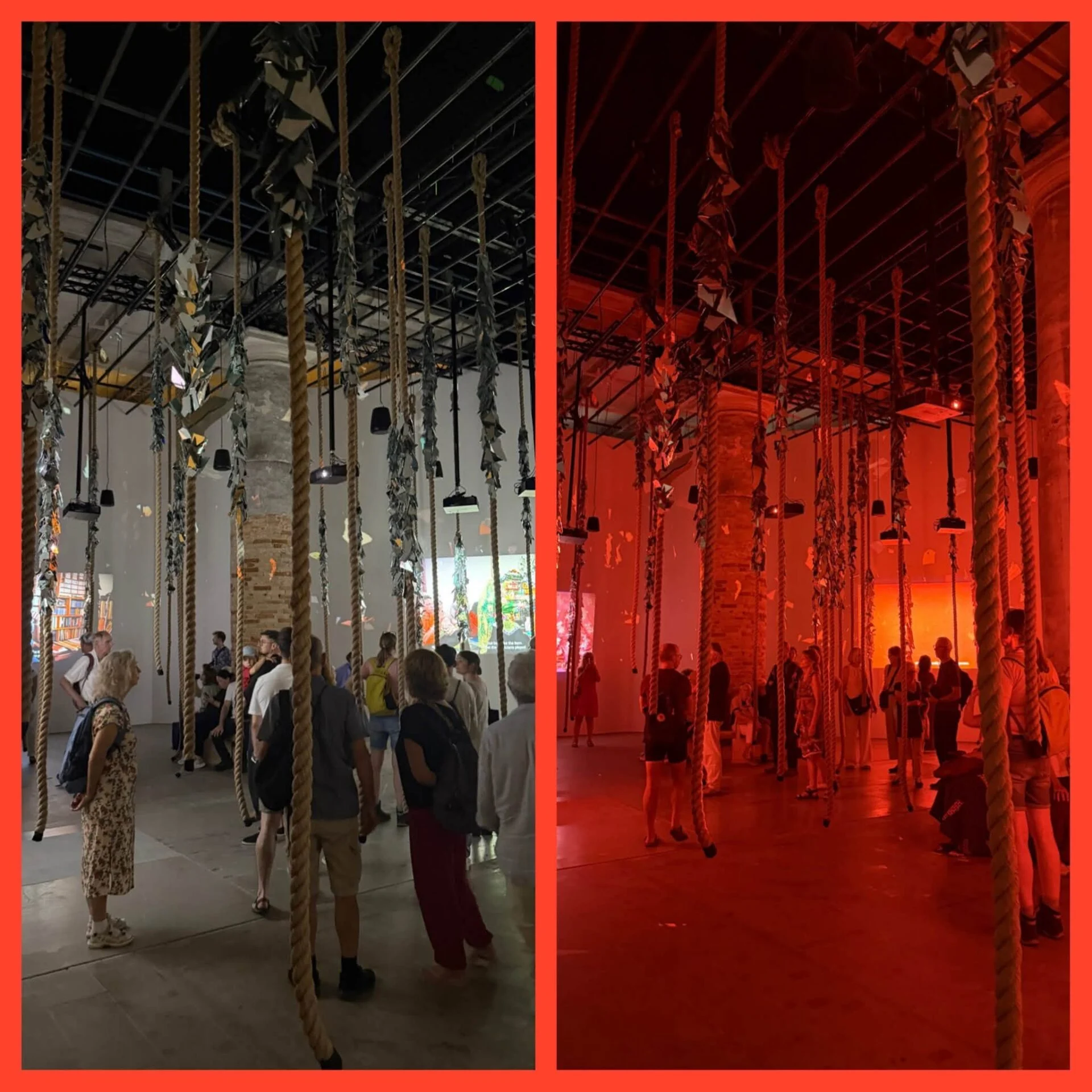
Mykolas Žilinskas Art Gallery and 'Man' sculpture by Petras Mazūras

26 August: museum home of Antanas Žmuidzinavičius

Today I visited the museum home of the landscape painter Antanas Žmuidzinavičius (1876-1966), a contemporary of Ciurlionis. Besides his studio and some of his private quarters, some of his works were also exhibited.
 
On the first floor was a temporary exhibition by painter Adolis Jonas Krištopats (1925-2000) to mark his 100th birthday: The Earth and Spring to One's Own Self.
 
Adolis works with fresh pastel colours with a strong touch here and there in a primary or secondary colour. In the 1970s, he mainly did expressionist portraits of well-known Lithuanians. After that, he gradually started to abstract more and more. Beautiful, fresh work, I liked it more than Ciurlionis' oeuvre.
 

Žmuidzinavičius collected 3,000 statues of the devil, which were displayed in an attached wing next to his home. It is the only 'devil museum' in the world.

Since I went to 'the devil's school' (Mortsel's non-Catholic atheneum) in my youth, I could not pass up this collection.
 
On the ground floor, figurines were displayed showing things the devil used in his vilaine tricks to trick or seduce people into doing evil: liquor (vodka), tobacco, music... and the disguises he used in the process.
 
The second floor documented the numerous folk tales that circulated about the devil.
Above were devils from almost all continents, or his relatives from local cultures.
 

The exhibition ended appropriately with a hail of angels, so you could leave the museum purified of all sins.

While strolling around the city, I came across quite a few murals. Under the Soviet occupation, graffiti was an expression of resistance. Today, numerous beautiful murals embellish the cityscape.

Antanas Žmuidzinavičius - Red evening (1912)

Share this post on social media

Read more...

en_GB