
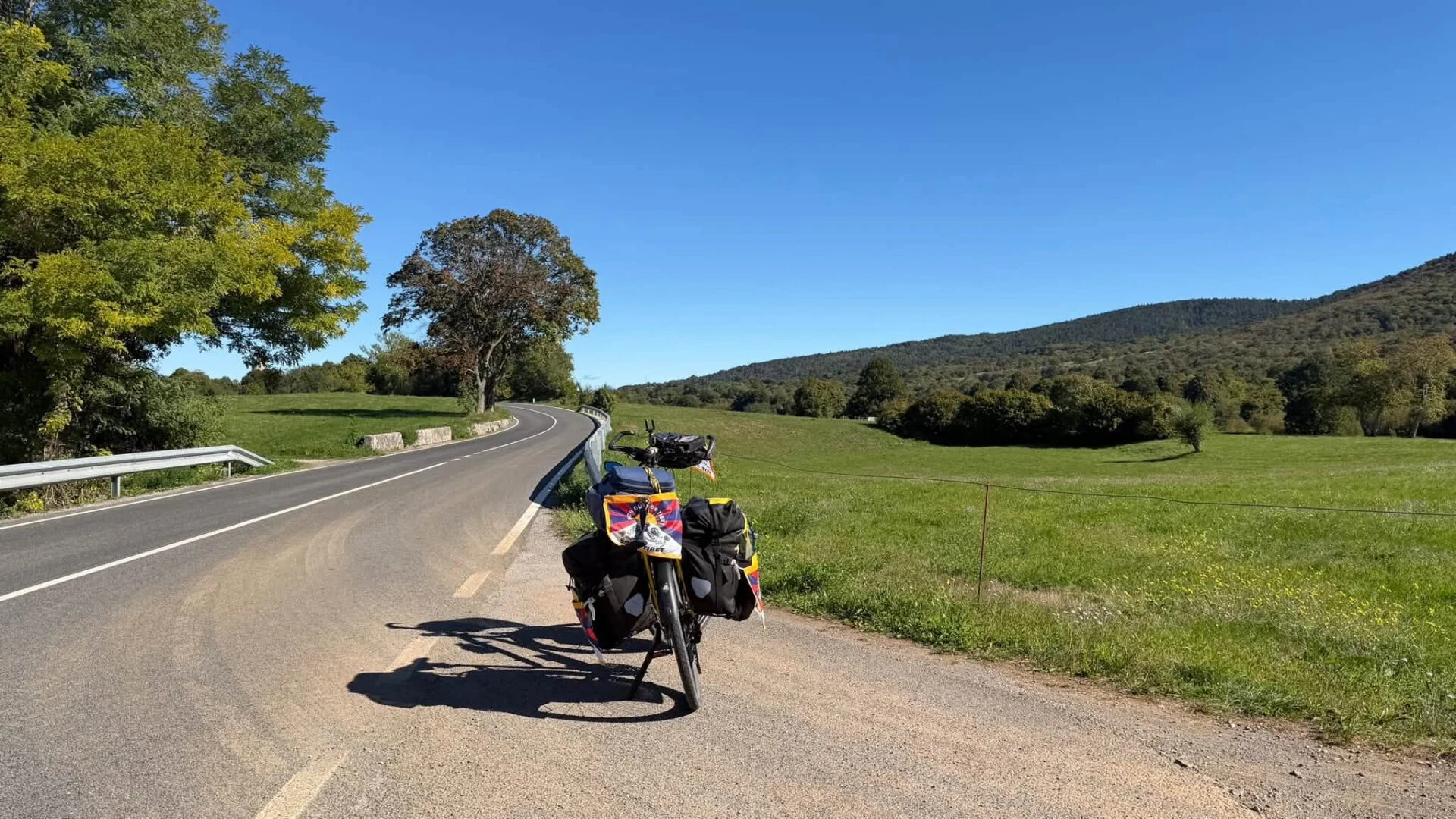
Around the Adriatic Sea 2026: Trieste – Dubrovnik
All photos: Balkan photos, city photos. The photos of the cycle route are listed in reverse chronological order. Those of the cities are listed chronologically.

Saturday morning was open weather in Andenes. By noon, we drove to the ferry port and already placed the motorhome in the queue. Then we had another hour to take a short walk into the village. Around 1pm, the ferry left for Gryllefjord on the island Senja, a 1h40 trip. Senja is a much rougher island than the Lofoten and Vesteralen. The mountains are higher and sharper and they descend directly into the fjord. As a result, the cycling route is again littered with short climbs over 'mountain roots'.


Gryllefjord
After about 20 km, the Eurovelo route FV862, a smaller and quiet road with a paved surface. That route started immediately with a climb of 300 altimeters and a gradient of 8% over 3.8 km. A teeth-grinder. What's more, it started raining heavily halfway through, which didn't exactly make me look forward to the equally steep descent beyond the pass....
The descent began through a poorly lit tunnel of 1.8 km. Fortunately, I had my Petzl headlamp put on, which still allowed me to see the state of the road surface several metres ahead of me. Upon exiting the tunnel, my glasses glasses immediately fogged up completely as it was several degrees warmer outside than inside the tunnel. Not exactly pleasant....
Beyond the pass, I saw that the sky above the sea was still open and blue. That meeting of fog, clouds and mountains on the one hand and the blue sea on the other produced very special light effects above the fjord. After the rather long descent, I was completely chilled and happy to start pedalling back down to warm up.

Between clouds and sun on the pass
Meanwhile, Els was in the lead looking for a place to spend the night. She found it 2 km off the track, at the fishing harbour of the village of Skaland. As she was waiting for me, she suddenly saw a school of dolphins passing in the fjord. Spectacular! Soon after, we also saw a seal and another swimming animal that was previously on a otter resembled. It had a long narrow tail for all intents and purposes, so it was definitely not a seal.
The warm light of the sun, which by now was already sinking low, produced very nice lighting effects on the little port in the foreground and the dark green mountains in the background. Meanwhile, it is midnight, and everything is jammed in fog. The free nature cinema is done...
Sunday was not a photogenic day due to low-hanging mists. The stage started with a climb to a tunnel and then followed the shore of the fjord, though with many short climbs over 'mountain roots'. A total of about five tunnels on this stage. 15 km before Botnhamn (ferry) a mild pass with a climb of 7% over 1 km.
After Brensholmen on along the shore of a long branching fjord with mountain root climbs to a quiet little sleeping beach at the end of the fjord, overlooking the water and in the company of our friend the mosquitoes.
Rainy in the morning, but still covered the last 33km to Tromsø able to travel dry. En route on a busy access road into town on the cycle path, I encountered my first reindeer. It then strolled peacefully into a residential area.

Reindeer near Tromsø
On Monday night we spent the night in a day-and-night car park in the centre of Tromsø So I went straight to the library could write a newsletter. Norwegian libraries are very well equipped, with coffee and beverage vending machines, plenty of seating and working space, plus a super friendly and helpful welcome.
Before I drove on in Tromsø I deemed it advisable to visit a bike workshop first because I was sometimes pedalling through my gears. A local had advised me to go to the Basecamp cycle and ski shop to go. The owner showed me that the teeth on the blades I use most were completely worn out. The two gear blocks and the chain needed to be replaced. One piece he did not have in the house, so he jumped on his motorbike and went to get it at a warehouse on the outskirts of town. What a service! By 6pm, everything was ready and I was able to leave with perfectly functioning gears. What a relief after all the misery I had had the past few weeks.
As it had already become so late, I drove only 33 km and we spent the night in a wide valley near a motorbike stadium which the Basecamp man had recommended as a quiet and safe camp site.
Wednesday morning started sunny with a brisk breeze. For the first 22 km I continued to follow the valley until Breivikseidet, where we took the ferry to Svensson had to take. In Svensby it started pouring, so I arrived soaking wet in Lyngsidet, some 23 km away, where we took the ferry to Olderdalen had to take. Fortunately, by the time we got there it had stopped raining and I was able to cover the last 20 km dry.
Low-hanging clouds made most of the photos greyish. We found a quiet camping spot near a closed campsite on a hill and again saw a deep-orange midnight sun light show behind the fjord and the misty mountains.

Midnight sun
Because on Wednesday night at the abandoned campsite in Djupvik had become after 1 hour because of the 'midnight sunstars' from a hilltop - where, around that hour, by the way, a woman with two young children was wandering around - we slept in a bit on Thursday morning. The day started quite brightly and the first part of the ride along the shore of the fjord cycled smoothly. Behind me were some glacier mountains which looked even more imposing from across the fjord water. After about 15 kilometres, a headland to be crossed. For cars, there was a modern 4.8km tunnel right through the mountain, which cyclists were not allowed to pass through, however. So a climb to the pass and a diversion of about two kilometres.
At the first intermediate stop in Storslett we visited an exhibition on the Reisa National Park and the way of life of the indigenous Sami people in the far North.
After Storslett there was a short climb over a headland and then I cycled again along the shore of a fjord to Oksfjordham, a village at the very end of a large fjord with stunning panoramic views over the water and the surrounding mountains.
There were already 52 km on the counter, but we decided to add another 20 or so until Sorstraumen, about 1h15 of cycling. However, that was outside the Kvænangsfjellet pass of 400 metres altitude, which required a long climb of 6% over 7 kilometres. A tough one, but the vistas from the pass were sublime. However, it was chilly and there was a strong wind, so I couldn't last very long there with my sweaty body, even with an extra rain jacket on.
As it was too windy and cold on the pass, we decided to start the descent. After one long hairpin turn, we found a sheltered spot next to the E6 close to some empty Sami huts a few dozen metres below where we could safely spend the night.
Over all this drive through the E6, the only road for through traffic here that actually has the status of a European motorway, I still racked up over 1,000 altimeters.

Near Rotsund
We awoke with a bright sun in the firmament. Before our departure, a Antwerp couple from Hoevene with a camper into the car park where we had spent the night. Thirty years ago they also travelled in Norway with a tent, and they were amazed at how much had changed since then. They gave us the latest on the heat back home.
The bike ride started easily with the continuation of the fast descent we had interrupted yesterday to spend the night. This was followed by a smooth cycling stretch alongside the fjord. However, Norway wouldn't be Norway without another hefty climb of 6% over 4.5 kilometres. With today's warm temperature (+20°), it was sweating.
The last part of the drive I saw three reindeer: two right next to the road behind the guardrail, and one jumped the guardrail from a garden and wandered into the mountains on the other side of the E6 via a dirt road. Beautiful animals, what a privilege to see them in the "wild" - next to the E6-- to witness.

On Friday night, we spent the night on a large open plain about 20 metres above fjord level, again with stunning views of the water and mountains.
Saturday was brilliant weather. The drive to Alta would be about 60 km are with about 1000 altimeters According to GoogleMaps. Usually GoogleMaps underestimates the altimeters, but fortunately not this time: in total, I cycled 910 altimeters.
A few kilometres outside our camping spot, we stopped at some Sami shops: wooden sheds or tents with reindeer skins, craft souvenirs and other tourist trinkets. Today's temperature was too high for the Sami shopkeepers: they stayed in the shade or in their shops.
The route continued through many short climbs until I reached a bridge and two tunnels at 10 km before Alta which cyclists were not allowed to pass through. Cyclists had to cross the fjord past a dam and then take a Climb 1.5km slope of 8% to get around the hill. A couple of beaches near the dam and on the hill had about a dozen camper vans parked, mostly from people who came to fish.
On our way we passed Kafjord, which had once been a copper mining village. In the graveyard was a realistic statue of a 'Rallar family', mainly immigrants from northern Finland and Sweden who came to work in the mines - and often died there.

Tunnel to Alta, banned for cyclists
After the first tunnel, there was a second tunnel through which cyclists were not allowed to pass and were diverted along an old road that first descended to almost fjord level and then went back up to the E6. The road continued to undulate for another 6 kilometres until it reached the city centre of Alta. This (shopping) centre looks very futuristic and tough. There are no houses, just shopping malls and large businesses and - by way of positive contrast - the beautiful Northern Lights Cathedral (https://en.m.wikipedia.org/wiki/Northern_Lights_Cathedral). The residential areas are lower, closer to the water.
At the very end of one of the residential areas, there was a road to a small beach where we could spend the night, close to the shore and away from traffic. An optimal place for a good and quiet night.
On Sunday morning, temperatures rose towards 30°. We stood on a beautiful little beach where from about 10 o'clock residents of the adjacent residential area came swimming and sunbathing on the rocks. So did brother and sister Kjell and Tove, who told us a punishing war story about Alta.
The conditions were too inviting not to splash to venture, so swimming costumes on and first carefully ankle-to-calf in the cold water - 17° according to the locals - and gradually deeper, moistening wrists and neck, holding breath and splash in. The tingling sensation afterwards when drying in the sun was lovely.
Two Norwegian ladies came to pick petals and leaves from the elongated purple flowers growing all over the roadsides to add strengthening herbal tea of it.
Around 4pm, I started cycling. In Alta is the first road sign showing Nordkapp mentioned: another 240km.
After 15 km along the banks of the Altafjord a steep climb of 7% over 4km to about 300m altitude, then a long gentle downstream beside a river to a lake, and then another climb to near 400m to the fjell, a very vast, desolate barren plateau. I had never seen such a wide landscape. Before the fjell, I saw several reindeer in the valley and on the slope across the river, including two snow-white ones.
On the plateau, there were a few lonely Sami huts or dwellings here and there.
We spent the night at the fjell In a small car park next to the E6, quite close to a wide, shallow river in which I could bathe pleasantly fresh, as it was still pleasantly soft.

Sami toilet on fjell
Another 25 km E6 follow over the fjell, downstream next to a river until Skaidi. With a tailwind of 19km/s, it flowed well. After Skaidi followed a climb to about 300m, and then again fast downhill with tailwind to Olderfjord, at kilometre 50. There, we swapped the E6 for the E69 to North Cape and the road again ran along the shore of a fjord with a jagged rocky coastline.
From our overnight spot on a protruding rock on the coast, we sometimes see rather large shadows passing underwater, followed by seagulls. Once again, we are in a ''room with a view'. Not conducive to sleep....
All photos: Balkan photos, city photos. The photos of the cycle route are listed in reverse chronological order. Those of the cities are listed chronologically.
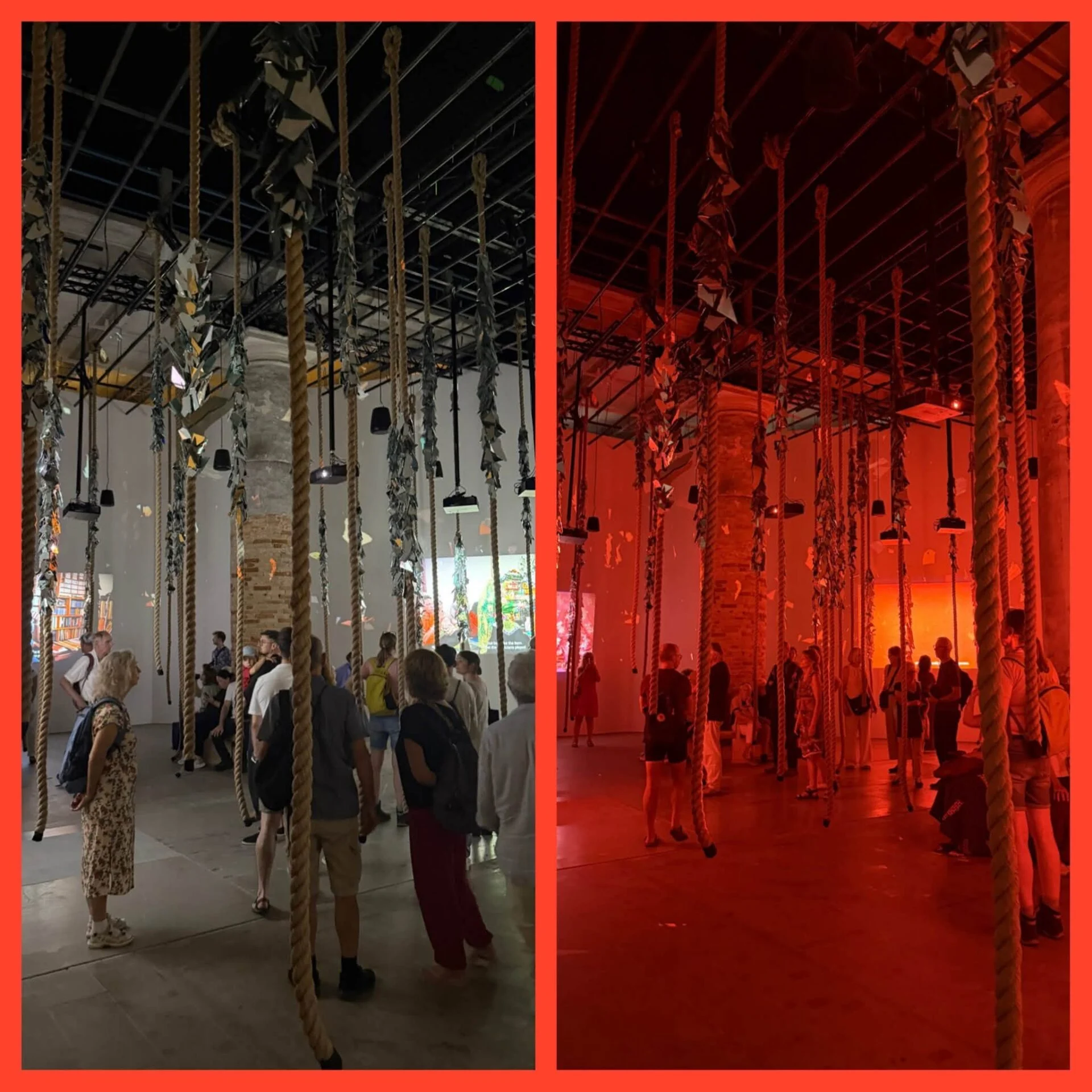
In Venice, I visited the Biennale at the Arsenale, the Giardini and various venues around the city. I also took the opportunity to see the Pinault collection at Punta della Dogana and a compelling exhibition by Michael Armitage at Palazzo Grassi.


