
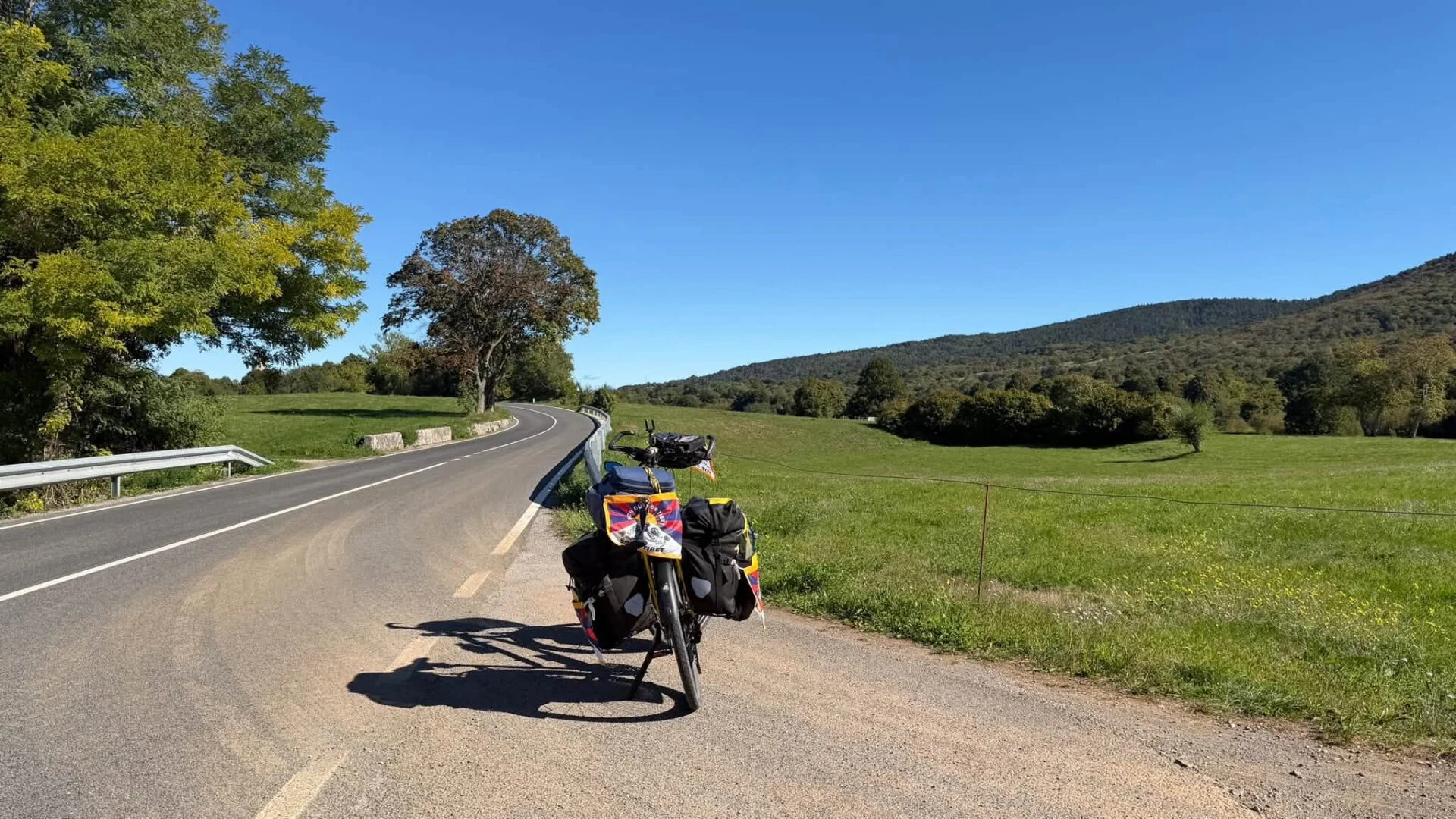
Around the Adriatic Sea 2026: Trieste – Dubrovnik
All photos: Balkan photos, city photos. The photos of the cycle route are listed in reverse chronological order. Those of the cities are listed chronologically.

A strong appetite today. The first stretch across the cliffs was all the time on gravel or grass paths, so I only progressed at a snail's - or rather frog's - pace. Therefore, I could Holy Island not visit. I had covered only 17 km in 2 hours, and Holy Island was 13 km extra, while I still had 60 to ride over a course I did not know. I did spend a long time on a log at the giant tidal beach near Holy Island zen-sitting and then did the Taichi form. So quiet and relaxing it was there.
Then it continued fairly brightly up and down country roads, but it was lovely cycling and in a summer temperature for the first time since the Hebrides. This forced me to stop at the flowery little station of Chathill at the station master's office to refill my water bag. Three litres was insufficient today.
The tour began with a 'Coquette' hurdle: to get across the Coquette River, I had to put the bike on four steps of a footbridge heisen. The little bridge was only just wide enough to get between them. The roadway went right through the river at the level of a constructed waterfall, about 15 cm deep at that point, but on two wheels over a slippery surface and with a fair amount of current, this I did not dare risk.
Just before Warkworth Castle I passed a sports field where a cricket match was busy. Understanding so little about that game, I positioned myself on a bench near the clubhouse.
It was nearing noon and Lynn, who provides refreshments and tea for the players, saw me sitting down and apparently thought I looked hungry. She gave me a milk tea and two scones With jam 'for the ride'. When she learned that I was cycling long distances to fund Cipriano's studies, I got another nice donation on top.
Lynn herself was until recently 'general sciences teacher' in primary education and appreciated any attempt to give underprivileged youth a future through solid education.

Warkworth Castle
After a brief visit to Warkworth Castle (12th century or earlier) I followed the Coquet tidal river to Amble. On the cycle path next to the beautiful river, I struck up a conversation with Evelyn, a very positive lady in a mobility scooter.
Amble is a cosy coastal town. I visited there a lobster farm/research centre and took a picture of a baby lobster. You normally never see them because they live the first two years of their lives under the sand. The crayfish were kept in separate compartments because otherwise they'd be at each other's throats. When they are fully grown, a notch made on their tail and they are put into the sea. That notch promotes fertility and lobsters with a notch should not be landed. Fishermen must throw them back into the sea. I also learnt there that the lobster genera are called 'hen' and 'rooster'.
Then the cycle path ran about 15 km behind the dunes with vistas to the beach. The last 20 km were less pleasant, with many busy roads as I Newcastle further.
I got to stay overnight in the Garden of the parents of the owner of Walkmill Campsite, because there are no tent campsites around here. Tent camping is no longer fashionable, or maybe it is not profitable enough....

Baby lobster
First through the suburbs of Newcastle to North Shields, river ferry across Tyne to South Shields, and then for a while along the coastal road with buildings on the right and on the left vast grassy cliffs.
Everywhere prevailed a summer beach atmosphere, it's a 'bank holiday' Monday here. From a cool 'cyclist chat' with Ian, I kept a donation for Cipriano.
The second part of the drive inland was largely over former railway lines who used to operate the coal mines. In the mid-1980s, Margaret Thatcher closed almost all British coal mines. I then worked in Glasgow for 3 months and experienced some of the miners' protests, led by then union leader Arthur Scargill. The workers were very bitter about Thatcher's harsh policies and went on strike and demonstrated for months on end. There was also a broad solidarity movement with many actions, but to no avail.
However, some of those railway tracks were so 'roughly' paved that I had to cross it on foot with my packed bike. At a bicycle gate also had to take off all my luggage because it was too narrow. For the last 15 km, I then set my GPS to 'auto', or I would never have got in before dark in Billyjeans campsite hit. A campsite of the old battle with a spicy sixties content: a large meadow, no electricity connections and only very rudimentary sanitary facilities. The visitors were all tent campers, but not all of the quiet type: because of the bank holiday Monday, there were already a lot of empty beer and wine bottles around some tents, and the decibels went up proportionally to the number of empty bottles . Fortunately, a little after ten, peace returned, everyone apparently respecting the campsite rules.
What did continue until well after midnight were the agricultural tractors. With the stable dry weather, farmers are now running triple shifts to keep their harvest dry inside.

Coastal route Amble-Whithley Bay.
The first 10 km today went flat on a good cinder track along a old railway line. The station had been repurposed as a café. This was followed by another miserable single track road with dense vegetation, where I was on a slippery piece of mud slipped under. Fortunately, I landed on a soft nettle bed, but I could go on with stinging arms and legs. However, a nettle bath turns out to be good against rheumatism. Only my right thumb I sealed a bit, which was a bit tricky when shifting gears.
To Middlesbrough get through it was again a lot of turning and turning along fairly busy roads, but then I got a view of the hills of the North York Moors National Park, which I have to get up and over tomorrow.
At 500 metres before the campsite I entered a down for a second time on a road with large loose boulders, fortunately with no additional bodily injury. Two totters in one day, it was my day.... The poor British cycle paths are already making me look forward to my last two cycling days in the Netherlands.....
Tomorrow I hope to draw some more beautiful scenery. The view of the sunset from my tent is already promising.
Today I was not very lucky.... To be sure GoogleMaps cycling navigation me again via unpathable paths would send up there on the Moors, I first submitted the proposed route to the campsite owner. He said it would include some gravel roads, but would be well cyclable.
The steep climb over the first few kilometres proceeded along a nice tarmac track, then followed a steep dive to a farmhouse in a valley, and then the tarmac ended and the misery began again over those coarse gravel roads with many stones, pits and furrows, and then steep climbs and descents on top of it. At one point, GoogleMaps wanted to send me left over a vaguely visible wild path Uphill and through heather bushes. Impossible to push a packed bike through there, so I decided to follow the gravel road further and see where I ended up.
At one point I came to a T-junction. I knew the left was the right direction, but according to all the digital maps I got loaded, that road ended up dead a long way down. To the right it went down steeply, but I saw that from that valley a steep tarmac road went up the next ridge. A better road for cycling(pushing), so from that tarmac road I would get on.
Just as I was about to start the climb over the tarmac road, I met the Dutch people who were camping next to me. They had gone for a walk and so I found myself right back at my starting point. Indeed, when I reached the top of the tarmac road, I recognised that it was where I had taken the steep dip to a farmhouse, after which the rugged part began.
Meanwhile, it was already after 13 hours and a second attempt to undertake a crossing of the Moors by a different route in the afternoon heat was beyond me. Because I definitely in Hull tomorrow must get to, I deemed it safer to stay near a railway line, and there are none on the other side of the Moors.
Some locals advised me cycling towards York (80 km) and there a train to Hull to take. This I did, and not via the cycle route, because, according to the locals, it was again on difficult and steep gravel roads. There was nothing to do but take a 30 kilometres of busy A roads to follow. Fortunately, next to the motorway-like A19 was a strip half a metre wide where I could drive a bit out of the way of the cars and trucks whizzing by.
From Thirsk I could again take calmer roads, another 50 kilometres or so to York. It was not yet six o'clock and I wanted to ride another 30 or so when the sky began to turn jet black. Indeed, thunderstorms were predicted. After Thirsk, I then entered the first the best campsite because I didn't want to end up in another heavy thunderstorm after this day. And in the end it took until 10 pm before it started pouring....
Tomorrow out of bed early to see the last 50 km to York cycling, and there is an hourly train to Hull there. That should work....
And next year I'll buy myself a good cycling GPS. No more farcing with GoogleMaps or with an Osmand that won't load maps just when you really need them....

Spinning around in North York Moors National Park
The thunderstorm for which I had dived into a campsite earlier than desired finally burst after 22 hours out anyway, with lots of rain and some firm thunderclaps. The rain gusts thankfully stopped around six o'clock, allowing me to have a dry breakfast.
At 8:30am I left for the Last 50km on English soil. When I cycled my last few miles in Ireland, Scotland and the Hebrides, a certain 'tristesse' overtook me each time because those (egg) countries and their people appealed to me immensely. Here in England I didn't suffer from that, I like what I have seen of this country not recommended for a long-distance cyclist, at least not on the routes I followed. There are beautiful villages, towns, coasts and nature reserves, of course, but also many busy urban areas you have to pass through for miles. And the cycling routes here are not always worthy of their name. 'We can do better on our own' Brexit country might want to look at many EU countries in this regard. The Sustrans cycling route network works with volunteers who do a huge amount of their best to map out as car-free routes as possible, but I wonder to what extent they receive government support and whether the government invests in decent cycle paths anyway.... The grinding roads you sometimes have to pass suggest not.
To end my last day of cycling in British style, I rode in the rain for another hour and a half. Summer was short in GB this year. A little before noon, I was in York, so I could get on the 12:50 train at my 1,000 leisure.
It also rained the last 5 km to the ferry terminal, but tonight a luxurious night in a private cabin with bathroom and an extensive dinner buffet. This is welcome after more than three months of simple one-pot meals. No wifi on the boat, upload text and photos in the Netherlands tomorrow morning.
At 9:30 I was through the border control and could start my trip across the delightful Dutch cycle paths begin. How relaxing it is to cycle here, with no passing traffic. The only possible fun-bearers are wind and rain, but today it was only the wind that was a bit counterproductive.
The 80km to Schijf, where Els would meet me with Bik, went smoothly, by 4pm I was at Schijvenaar campsite.
And even in the Netherlands I unexpectedly had to do some pretty heavy bicycle pushing, over a steep footbridge, with some stairs at the bottom, over a motorway.
Last ride to Antwerp tomorrow. It has flown by....

Unexpected obstacle in the Netherlands
Like last year, a beautifully decorated door and a very hearty reception committee consisting of my three lovely neighbours (main photo).
All photos: Balkan photos, city photos. The photos of the cycle route are listed in reverse chronological order. Those of the cities are listed chronologically.
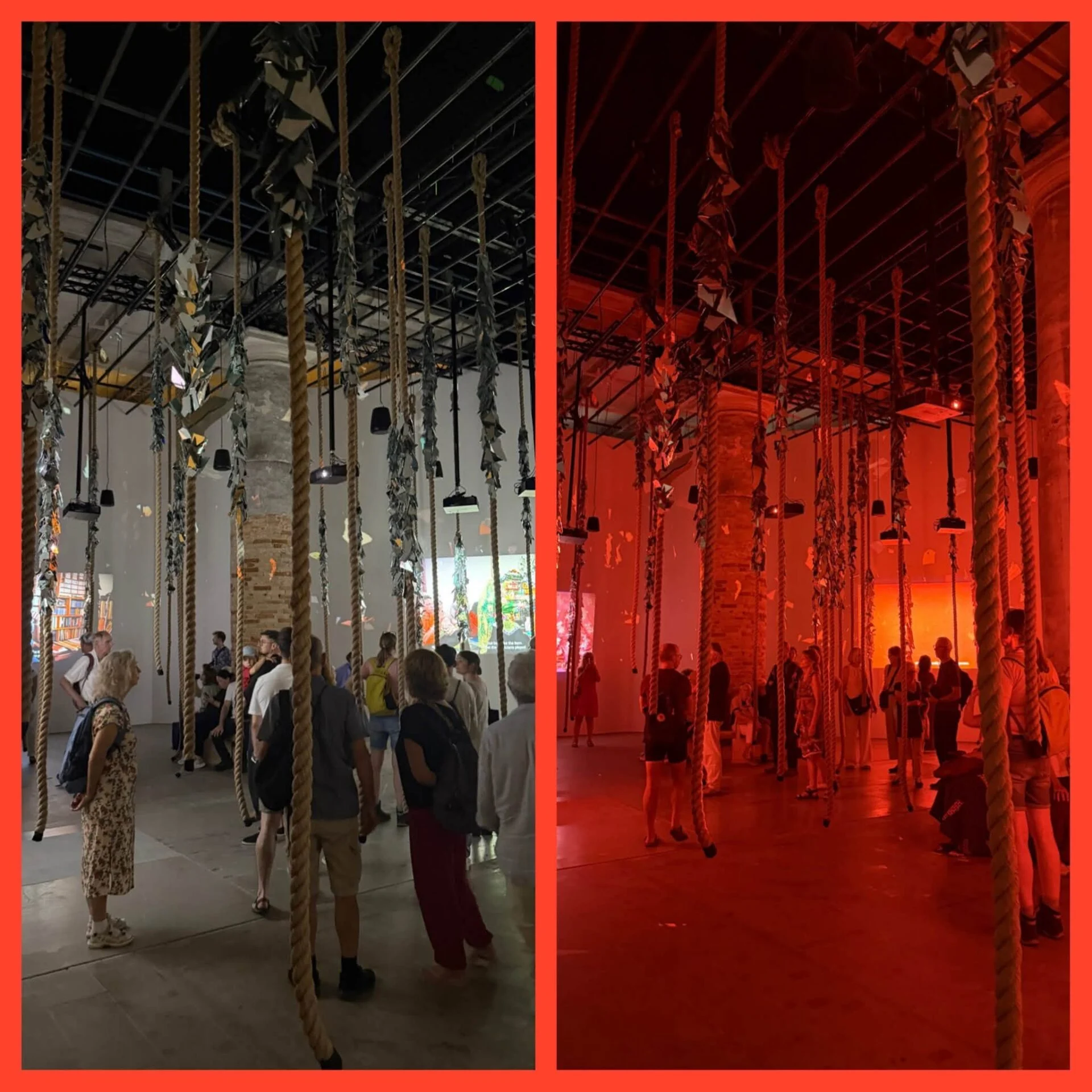
In Venice, I visited the Biennale at the Arsenale, the Giardini and various venues around the city. I also took the opportunity to see the Pinault collection at Punta della Dogana and a compelling exhibition by Michael Armitage at Palazzo Grassi.


