21 April: Salamanca - Tordesillas (84 km - 370D+)
A long but very easy drive today! The nearest campsite was +80 km from Salamanca. A long drive but the weather forecast promised a tailwind of +30 km/h. And that's what I got! Apart from the few inclines, I hardly had to pedal. The storm wind just pushed me forward. I rode at a average speed of 20.5 km/hour, which is unseen fast with a fully packed bike! What a luxury on such a long ride!
At the campsite, I met a cycling couple coming from the opposite direction. Their average speed was 10 km/h. That's how big the difference is between strong tailwind or headwind. I was very lucky today.
The smooth cycling was very pleasant, but the ride and landscapes rather monotonous. I decided to take the shortest route via the N-620, as I expected it to be traffic-free since it runs parallel to a motorway. I was right, all motorised traffic took the motorway except on a 20km section past the village Alaejos: there, the road surface of the highway was being repaired and all traffic was diverted via the N-620. Bad luck, but I had no problems thanks to the very wide breakdown lane.
Moreover, I recently learnt why Spaniards are so careful when cycling: if they hit a cyclist, they always have to pay a €1,000 fine, regardless of who was at fault. A very efficient measure, it turns out!
22 April: Tordesillas - Cubillas de Santa Marta (59.8 km - 520D+)
Today there was less wind and I could pedal normally again. Moreover, the fantastic N-620 stopped here and I had to continue on smaller provincial roads with more altitude metres. Up to Valladolid however, the landscape was beautiful: vast undulating green fields fringed by flattened hills covered with pine trees.
At Simancas I met artist/poet Miguel Segura. He wanted to show me the way to the Camino de Santiago, but when I told him I was on my way to Valladolid and Cubillas, he showed me a nicer alternative gravel route via the Canal de Castilla. How nice of him!
The last 15 km to Cubillas I followed a less idyllic but paved road that ran parallel to the motorway. The campsite in Cubillas itself is also right next to the motorway, so tonight I sleep with earplugs in.
23 April: Cubillas - Torquemada (41.4 km - 240D+)
The roads here are getting worse and worse: to get in a straight line to Burgos to get there, there is only the motorway, which I may not take. The provincial asphalt roads normally run perpendicular to the highway, so not in the direction I need. As a result, I had to cycle 24 km on very rough gravel paths with lots of stones, so I moved very slowly. Although I always fear that the frame of my poor second-hand bike will break on such bumpy roads, it was the clasp of my left ORTLIEB pannier that broke. Fortunately, I was able to repair it provisionally with two straps.
Sometimes I wonder why I travel with so much repair stuff, but at times like this, when somewhere in the middle of nowhere something breaks down, you are glad you carried it for almost 5,000 km!
At 16:30, after less than 41 km, I reached Torquemada. Although I had planned to go to Quintana del Puente to go 15 km away, I decided to go into the cheap Hostal Catalina de Austria de Torquemada to stay. There is only one hostel in Quintana and besides, today is 'Dia de Castilla y Leon', a public holiday. The hostel reception might be closed if the owners wanted to attend one of the festivities in the village. In hindsight, I had made the right decision because half an hour later it started raining.
24 April: Torquemada - Burgos (81.9 km - 810D+)
Since I stopped early yesterday, I had a long drive to Burgos ahead. Komoot suggested a route with 25 per cent gravel. Not wanting to be delayed because of bad gravel roads, I mapped out my own route, with only 7 per cent gravel. That 'luxury' cost me an extra 5 kilometres and more altimeters.
It was a very rewarding route, very quiet roads through beautiful landscapes. I also passed several medieval bridges and picturesque villages.
The gravel sections were much easier than yesterday as they had fewer potholes and their surface was much smoother with fewer stones. Too bad one never knows this in advance.
What was not so nice was that the last 30 kilometres contained many long and quite steep climbs. After each climb, I hoped it would be the last, but then another one popped up. And another, and another... This was very tiring, also mentally, and I was very happy when I finally reached the Cathedral of Burgos saw looming after the final climb. Happy and exhausted...
26 April: Burgos - Monasterio de Rodilla (32 km - 310D+)
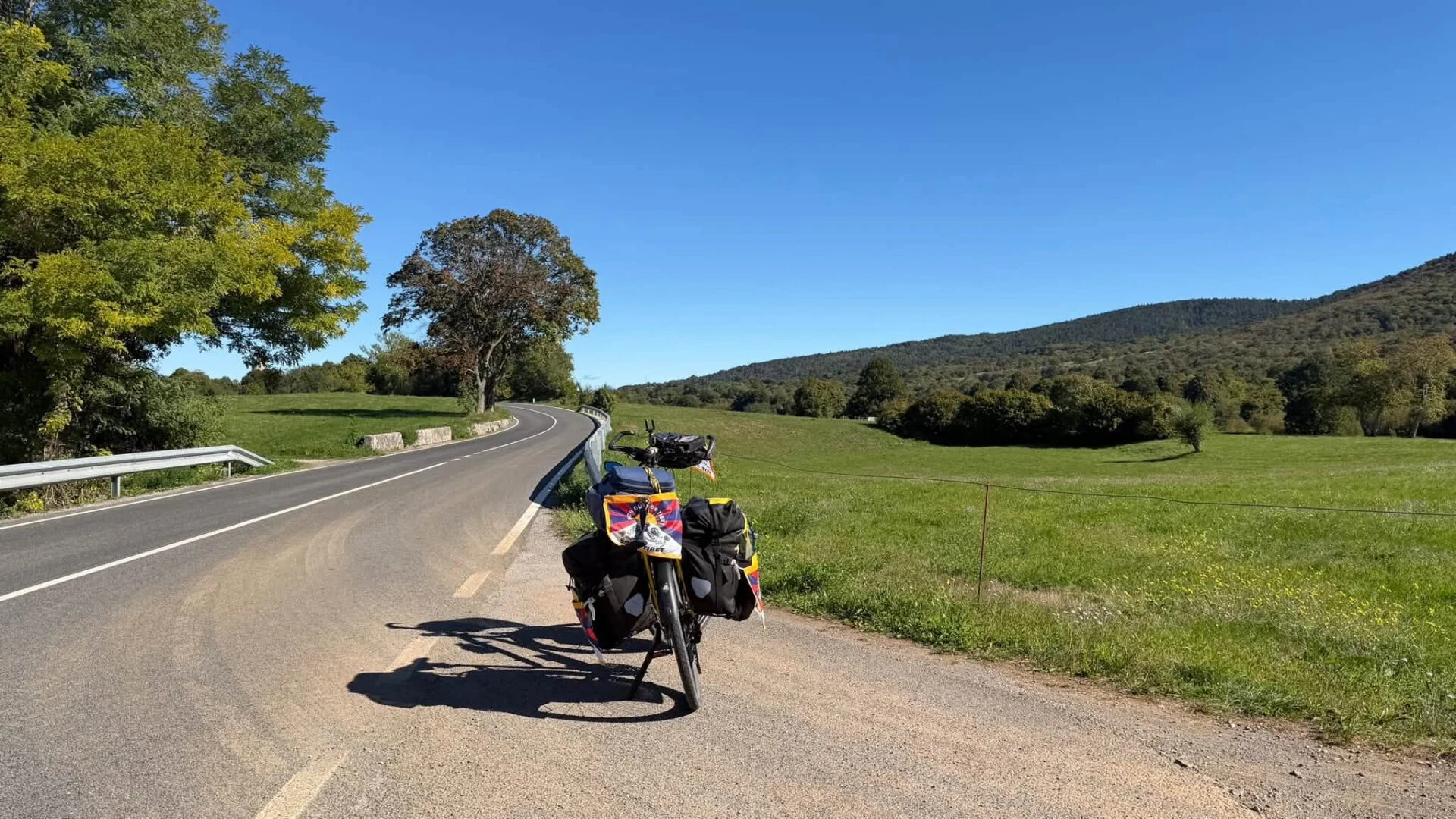
Very nice ride today. Leaving Burgos went very smoothly: I set off along beautiful cycle paths and wide and green boulevards.
The rest of the ride was also very nice, on county roads that went gently up and down, except for one long and steep climb past the village Valle de las Navas.
Monasterio the Rodilla is a beautiful old village with several Romanesque churches and shrines.
April 27: Monasterio de Rodilla - Nuvilla (74.4 km -400D+)
When I go into Arrasate want to be there to pick up the new quick lock for my pannier, I have to travel 72 km today. The meteorological service predicted some headwind. For about 60 km, I had the luxury of a good and quasi deserted N-road. So I opted for the easy cycling instead of the provincial roads with many more altimeters. The N-1 follows a wide valley. A less charming stretch: just pedalling with my mind at zero.
After about 13 km I reached the small village of Cubo de Bureba. A village with a history, though. In 1807, 20,000 Napoleonic troops camped here to wait for Napoleon and their attack on the city Burgos prepare. More explanation via the button below:
The poet and filmmaker Manuel Atolaguirre (1905-1959, belonging to the generation of '27) died in a car accident here.
I cycled parallel to a mountain range and wondered where I would have to cross it, as my GPS had not anticipated a long climb. And lo and behold, just past the village Pancorbo the road turned right into a ravine and then a tunnel. With no altimeters!
In Rivabellosa, I bought food because tomorrow is a local holiday and everything is closed. From there I had to take a hilly local road up to campsite Roble Verde, with various push-bike sections that were too steep for me. The icing on the cake after a long day of cycling.
April 28: Neville - Arrasate/Mondragon (65.1 km - 540D+)
My legs were still tired from yesterday's long ride, so I had a tough day of cycling today. Fortunately, I was able to avoid some of the steep climbs suggested by Komoot by taking alternative roads. I cycled directly to Vitoria, where I stopped for lunch. After lunch, I took a road that went through the old city centre and took some quick photos, without, however, visiting those sites.
Beyond Vitoria, I could see a quiet Via Verde follow through to Arrasate.
My plan to use the replacement quick release system for my left pannier in Arrasate pick up failed. I arrived around 6 am, but the bike shop was closed at 3 am and would not reopen until Tuesday as Monday is Labour Day. I cannot wait that long as there is no cheap accommodation in Arrasate.
April 29: Arrasate - Itxaspe (46.4 km - 510D+)
After a long and restful night's sleep in a comfortable room in Hotel Arrasate, I felt well rested and ready to cycle to a campsite on the Basque coast. My legs felt twice as strong as yesterday. The weather was grey and misty and the temperature would not exceed 17 degrees.
Much of the way I could see the beautiful Via Verde Vasco Navarro follow.
The landscape has changed a lot since yesterday. The hills here are very steep, with almost vertical slopes, and the valleys are narrow and carved deep into the rocks. No more vast panoramas as in Castilla y León and Extremadura. I am not really a fan of these oppressive hills. The road followed the winding Deva-river and after every bend you are faced with another steep green wall. But again, I admired the Spanish road infrastructure. What roads and bridges!
It was a very comfortable ride until the last 3 km. I then had to climb from sea level to 225 metres in one continuous climb with sections of 7 per cent. This was followed by a 2km descent along a local road to the beautifully located Itxaspe campsite, overlooking the Atlantic Ocean.
A very quiet location, but it means my ride tomorrow starts with a 2km climb back to the main road. 🥵
Some time after my arrival at the campsite, I arrived Els van Vlimmeren from Belgium with her dog Jack. She will follow me for a while with her camper van, so I can cycle less heavily packed 😀 .
May 1: Itxaspe-San Sebastian
This morning around 7am, it started raining and there was a very dense ocean fog. Poor visibility again for cycling along a busy coastal route.
Fortunately, it started to clear up after 10h and I started packing my tent. All my tent stuff could now go in Els' camper, so my bike was much lighter and the 2km climb of Itxaspe campsite to the N-634 was much easier than before.
After a long descent back to sea level, the road followed the rugged coastline and passed a few villages. In the afternoon, even the sun broke through the clouds.
Once again, I faced one very steep hill in the last 4 km where I had to push my bike up again on foot. The steep hills in Basque Country Are hard nuts to crack for cyclists!
2 May: San Sebastián-Saint-Jean de Luz
Luckily no more climbing to get from the campsite to town San Sebastián to come. I cycled along the beautiful beach promenade in San Sebastián and took a few pictures of the emerald blue ocean. When I went back to my bike and wanted to attach my phone to the phone holder on the handlebars, one of the two closures broke off. Bad luck. Fortunately, I was able to temporarily secure it with a strap. Before siesta closing time, I went to two bike shops, but my phone did not fit in any of their phone holders. So I continued with the strap, which was more or less fine.
At San Sebastián I met Pilar Guembe and her husband. They were interested in my tour of Tibet and knew very well how China mistreats Tibetans and other minorities. They also told me the story of the 'Agotes', a people in the Basque mountains who lived in complete isolation for almost 500 years because they were considered 'pestile'. I will try to find some more information on this issue and write a separate post on it.
The roads between San Sebastián, Irun and Saint-Jean de Luz were crowded and not very relaxing to cycle. They also involved a lot of altimeters. As soon as I crossed the French border, cars passed me very close again. The French treat cyclists much less politely than the Spanish. This is something I will have to get used to again.
I think I'm going to miss Spain.

16 September: Opening the door at Diamondway Buddhist Centre in Tallinn The centre's meditation sessions are open