Walking to a restaurant my first evening, I bumped into the Neue Synagogue, which stood glowing hot gold in the setting evening sun.
Since there are so many beautiful museums, the next morning I first went into the nearest tourist info to get a museum pass buy. That was in the Humboldt Forum, and that's where the 'Berlin Global' exhibition, about the city's history from an international perspective. I planned to take a quick stroll through it and then go to the Hamburger Bahnhof museum for contemporary art, but I ended up sticking around for over two hours. It was quite interesting with lots of historical audiovisual material.
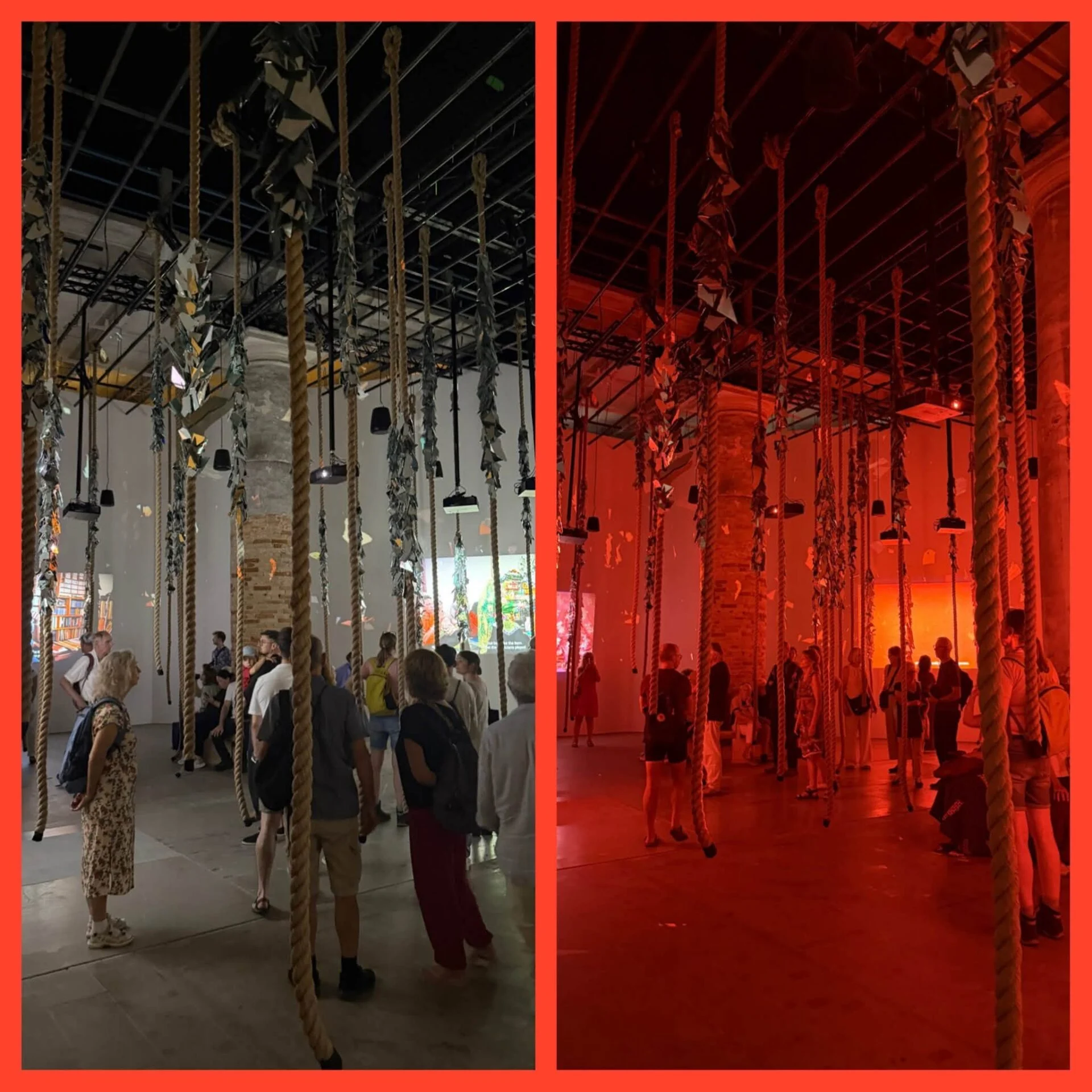
The work of Naama Tsabar in the Hamburger Bahnhof Museum requires a word of explanation: she strings large thick pieces of felt and puts them at a certain tension so that they produce a sound when the strings are touched. With this, she made a large music installation.
It stayed with those two museums today.
Because I had seen videos in 'Berlin Global' of the Potsdamer Platz in 1989 - a big muddy plain with pieces of demolished wall-I cycled there for a while to see the contrast with now.
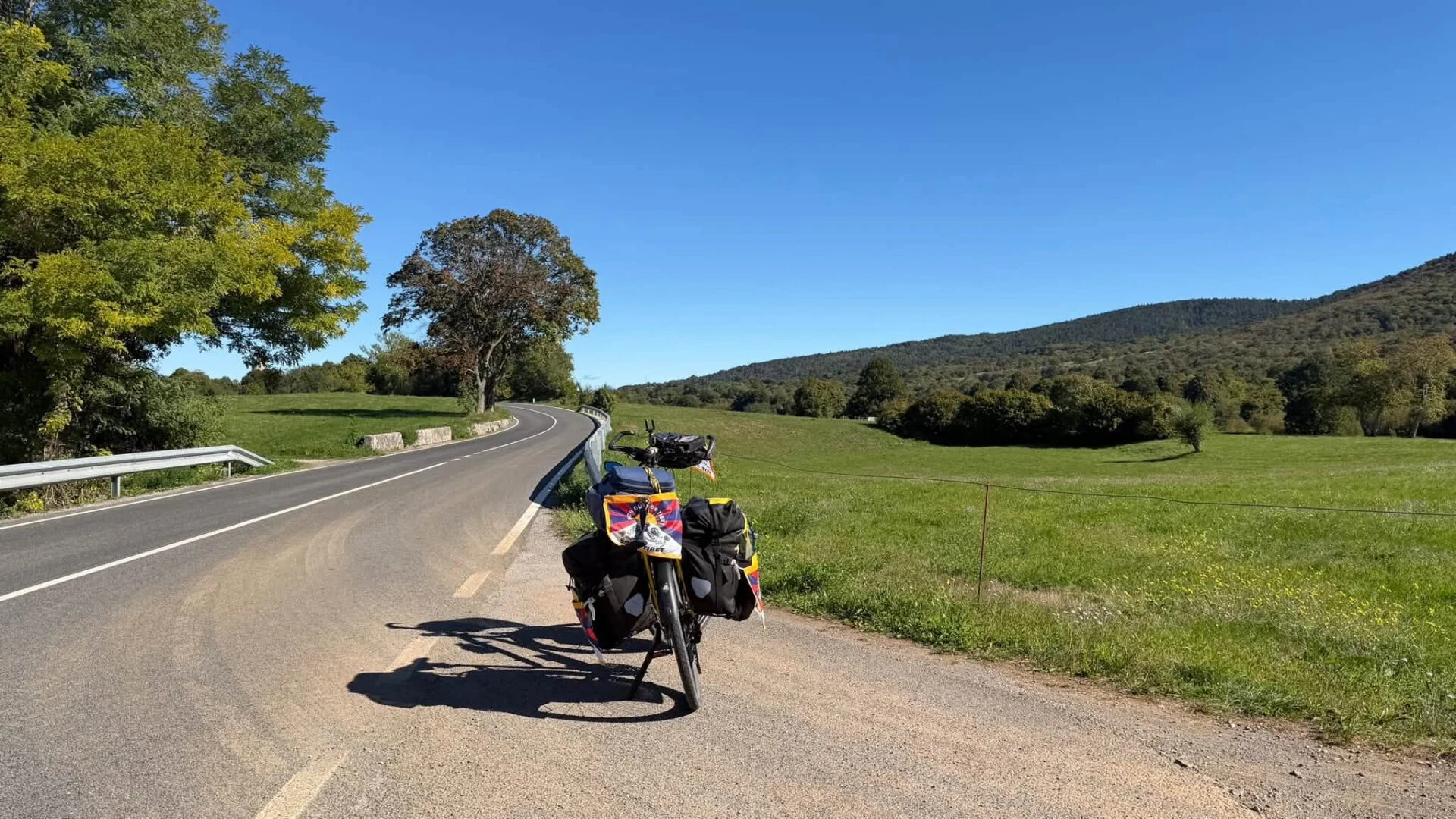
Also, some cityscapes from on the road by bike.
Work Naama Tsabar
This morning I cycled straight to the Neue Nationalgalerie, a building by Ludwig Mies van der Rohe (1886 - 1969). Three exhibitions ran: Art Between Politics and Society, with works from the permanent collection from 1945-2000: All the major 20th-century art movements were represented with the big names, mostly from the West but also contrasting with them a number of works by Eastern European artists. After reunification in 1990, a number of Eastern European artists were added to the collection.
The second exhibition: 100 Works for Berlin by Gerhard Richter, one of my favourite German artists.
And finally, an extensive exhibition on Andy Warhol, with work from his early days to the mid-1980s. Not the famous soup cans or Marilyn Monroe & Co screen prints, but work that focuses on the (mostly male) body and (gay) sexuality. Work that was still heavily taboo at the time and almost nowhere shown.
Neues Galerie
This long museum visit was interrupted in the afternoon by a meeting with Kai Müller, the director of International Campaign for Tibet Deutschland. Cycling 14 km there and back to his office, getting a good breath of fresh air. How glad I am to be here by bike and keep coming across all kinds of interesting things along the way.
With Kai Müller and Erich Mayer of ICT Deutschland
My last day in town, and last night in a bed with a lovely pillow .
I had yet to see any museum on the Museum Insel done, even though that is within walking distance of my hostel. I love watching the stylised Egyptian art and headed to the Neues Museum, where the world-famous bust of Nefertiti state. However, no photography was allowed in that room. Like most museums here, this one is 'colossal'. I walked through it quite quickly for my standards, but still spent another +2 hours there.
Bust of Nefertiti
In the afternoon, I cycled to the Libeskind Bau, designed by Jewish-American architect Daniel Libeskind. The design is called 'Between the Lines'. It tells the history of Jews in Germany.
The building is difficult to describe in a few lines, you have to see it, or better still, experience it for yourself. The floors are not horizontal and the walls are a bit crooked. Many long straight lines but almost no right angles, and also some empty (void) vertical tubes that cut the building from bottom to roof. Actually an interesting building to make a 3D puzzle of.
On the ground floor, you will find three axes: exile, for the Jews who fled (=survivor); Holocaust, for those who remained in Germany.... That axis ends in a dark room, the Holocaust Tower, lit only by a spigot of natural light at the very top. That tower is also one of those vertical tubes. The third axis is that of the 'sequel'. 'That one leads first to a gripping artwork with 10,000 steel faces of Menashe Kadishman into another vertical tube. Then you take a high staircase (there is also a lift) that leads you on the top floor to the permanent exhibition. Which again was far too extensive, I couldn't see everything, let alone read it, and only took a photo here and there.
After the Jewish museum, I ate a snack and, on the recommendation of another friend, cycled on to the neighbourhood Friedrichshain. The place was pleasantly crowded, but it had started pouring on the way, so I dropped off back to my hostel.
Libeskind Building

16 September: Opening the door at Diamondway Buddhist Centre in Tallinn The centre's meditation sessions are open