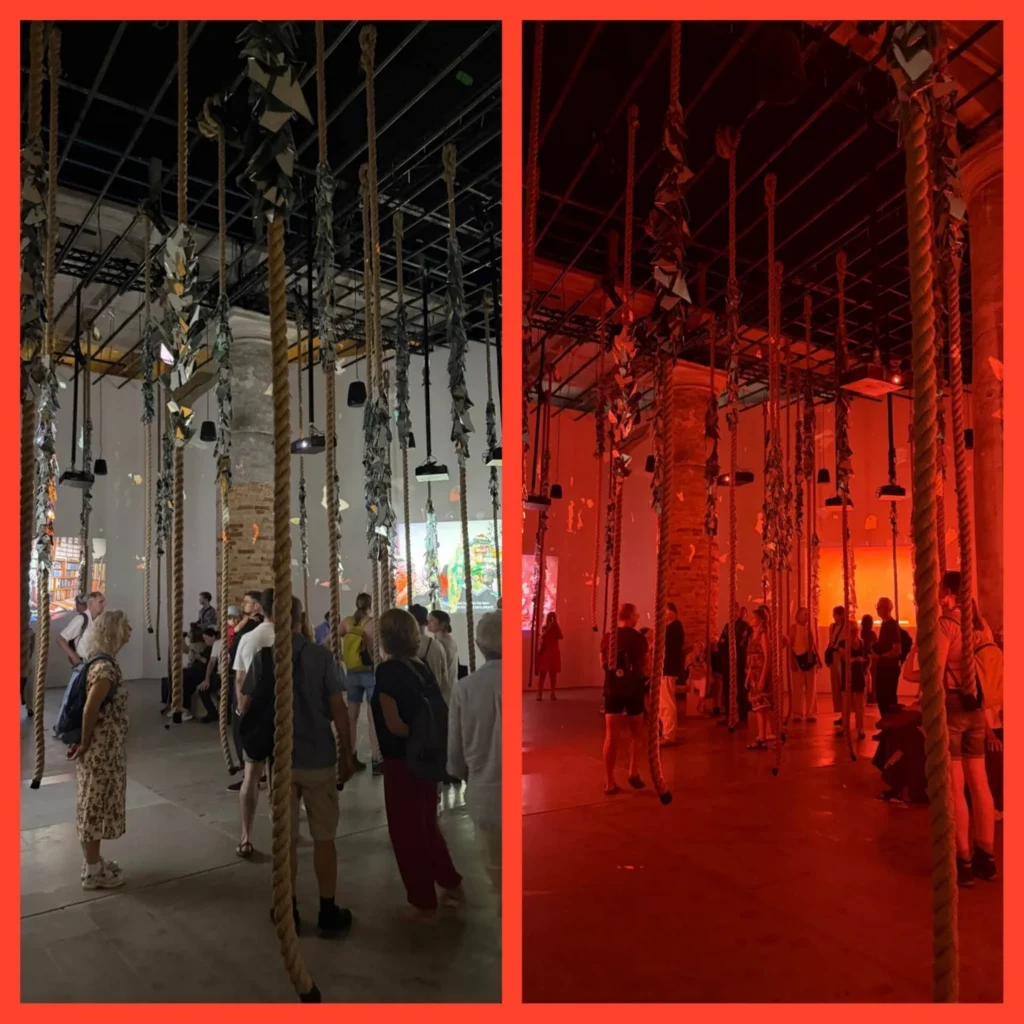
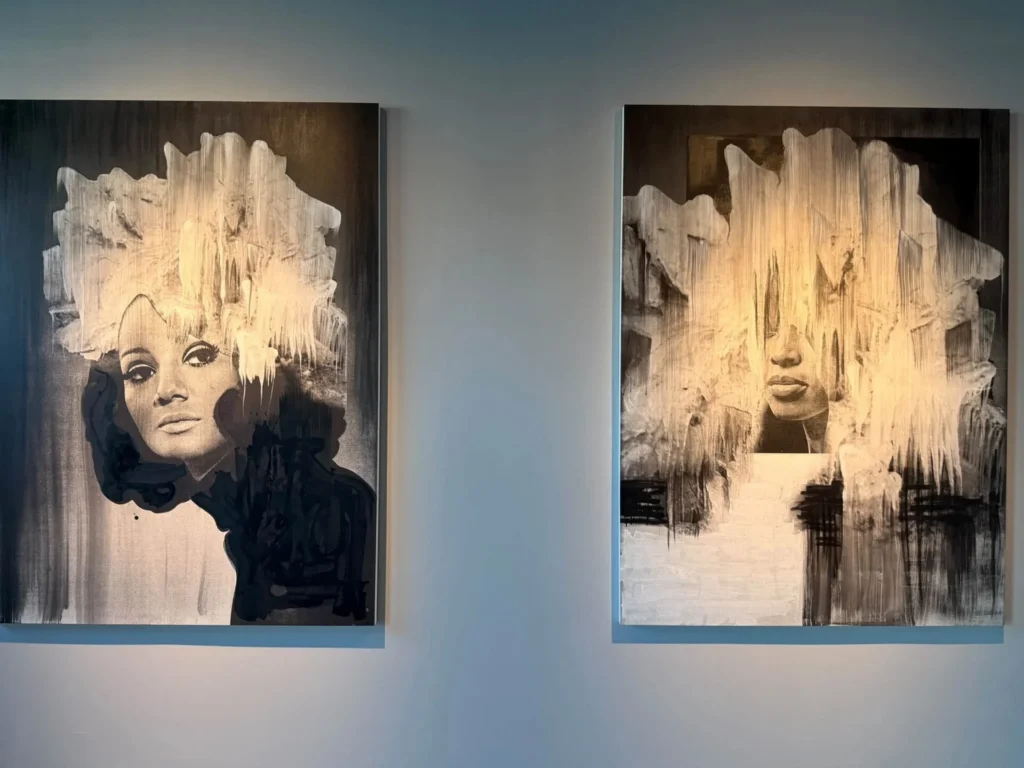
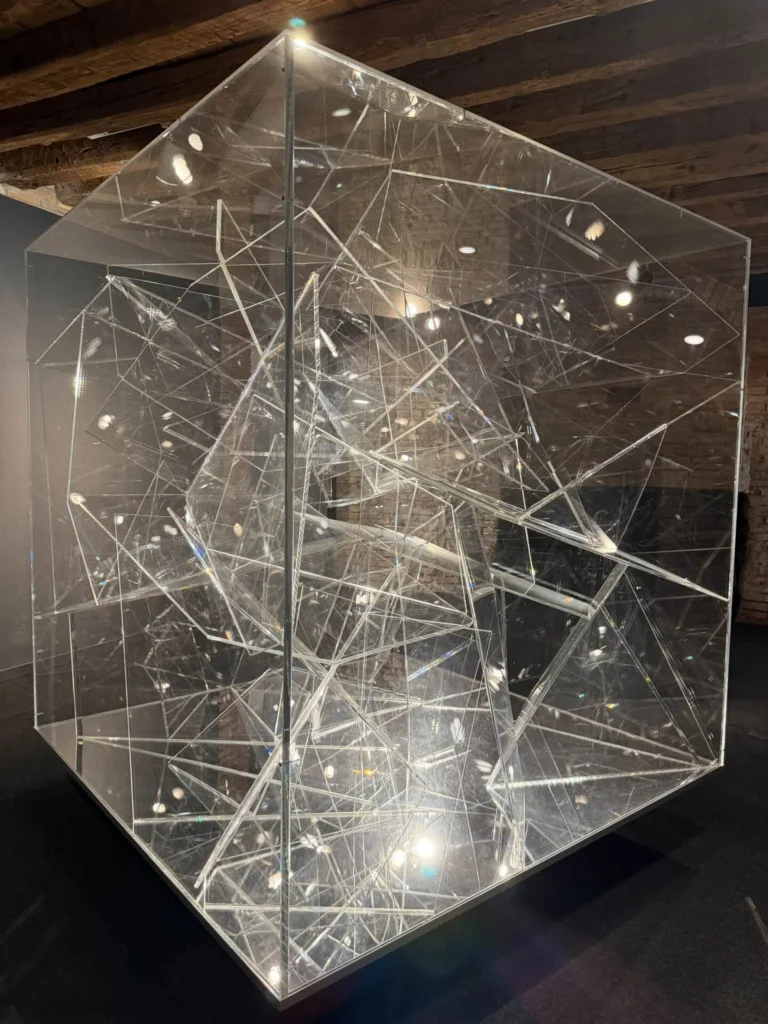
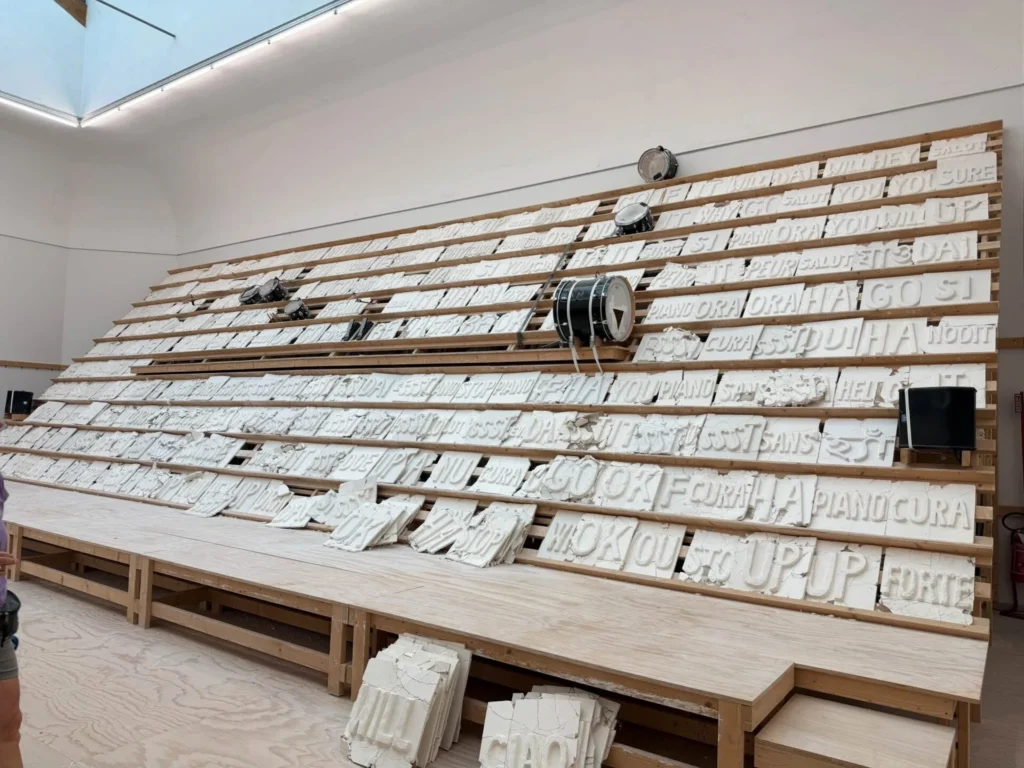
I started with the main exhibition. I’ll refer you to the photos for that, but I’d like to say a few words about one artist: the work of the Japanese Yoshiko Shimada. It was about feminism in Japan’s patriarchal society. I found her interpretation of her work interesting:
“Following the emergence of a strong anti-feminist movement in Japan in the 2000s, it became largely impossible for Shimada to exhibit her work.
That is why Shimada began researching the art and politics of the 1960s and 1970s, a period that paved the way for the third and fourth waves of feminism.
Shimada’s most recent work focuses on the feminist political group Chüpiren; this was a militant organisation that emerged in the 1970s and used street theatre as part of its activism. Recognisable by their striking pink helmets, these activists – led by Misako Enoki – for access to contraception and for sexual and reproductive health.
Their causes still resonate with the current struggle for women’s bodily autonomy. To this day, it remains the only feminist movement in Japan to have run a national election campaign.“
One piece of work that I really liked was by Hala Schoukair, Lebanon.
I didn’t take very many photos in the national pavilions. There were lots of monumental installations that you have to ‘experience’ but which are difficult to capture in a photograph.
Spain screened ‘Los Restos – The Remains’ by Oriol Vilanova. A comprehensive history told through thousands of postcards, arranged by theme and spread across various rooms. What a painstaking task it must have been to collect those postcards and then organise them by theme and colour as well.
In the Serbian pavilion, there was something similar, but with a more significant political and social dimension. Predrag Djakovic In his installation ‘Through Golgotha to Resurrection’, he documented the history of the 20th century using newspaper cuttings, banknotes, stamps, share certificates, etc.
He also painted a long, beautiful piece of text on a wall, which I could only make out in a video.
The Greek Andreas Angelidakis created an ‘escape room’ with funny photo effects. Playfulness, arte ludens, but with a serious message about the state of the world.
Australia presented a work that, at first glance, appeared static but, on closer inspection, was in a state of constant, subtle motion, whilst Japan apparently took up the ‘Have more babies’ slogan coined by our Antwerp-based civic leader Van Doesburg. Or perhaps she drew inspiration from the Japanese pavilion… An entire pavilion full of baby dolls to counter the decline in birth rates in the West.
Of course, a photo of the Belgian pavilion was a must, but without the performances that go with it, it doesn’t mean much.