A little sleep in and a languid morning in the campsite does some good. Only around noon did I leave for town. Some strolling around the old town, despite the crowds, the beautiful, homogeneous, mainly 19th-century architecture Admiring, searching a pharmacy for a tube of Arnica for my aching wrist.
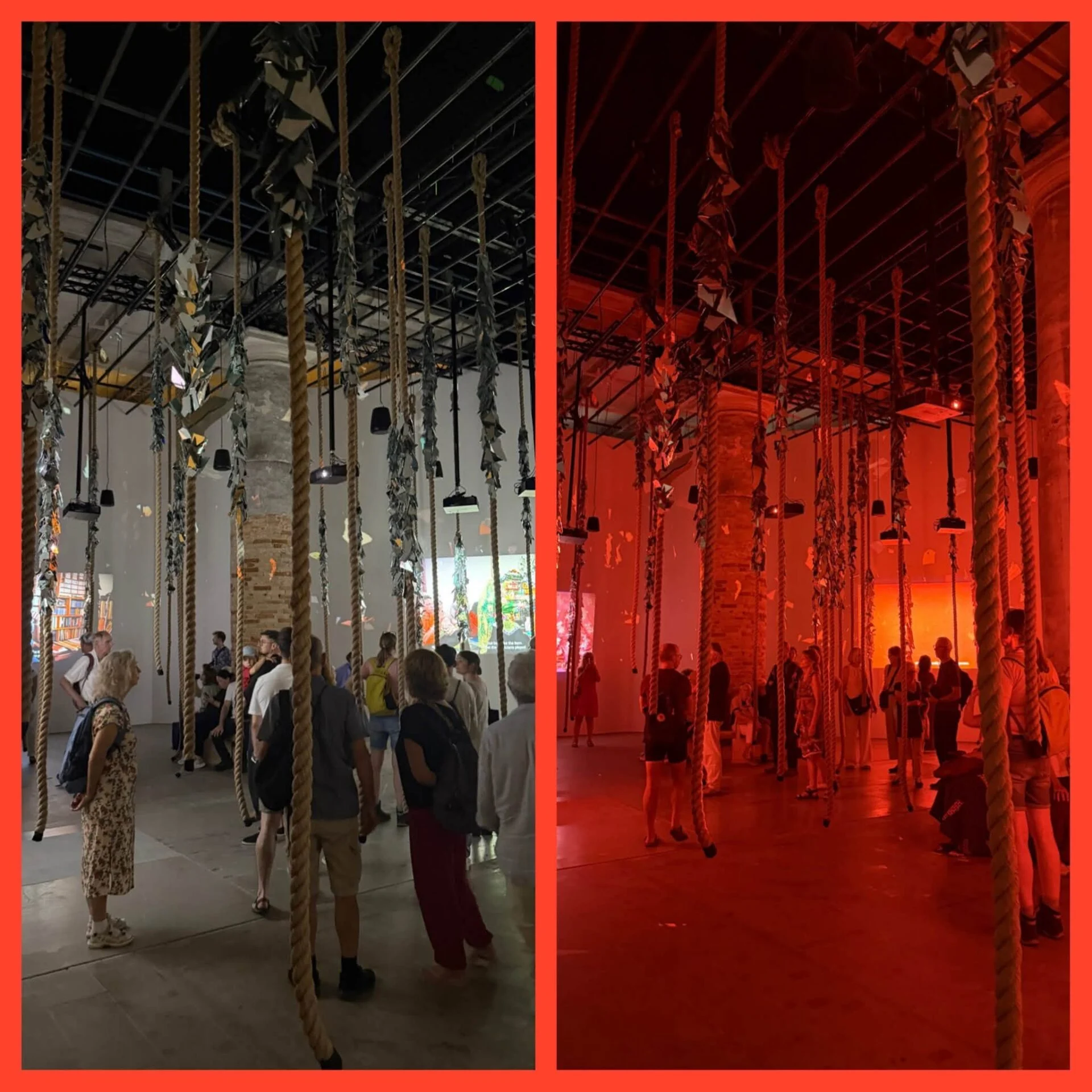
Along the way, I came across an unexpected gift: DSC Gallery with remarkable work by one Milan Houser - which was unfortunately difficult to capture on camera - and Jakub Matuska, and in the Central Gallery on the Old Market to an exhibition featuring the work of Salvador Dali and - again - Andy Warhol.
The Warhol exhibition was less provocative than the one in Berlin: family photos, his famous 'series', record covers and his filmographic work.
By Dali many etchings and lithographs - always work in very large editions of several hundred to even a thousand copies, Dali was a shrewd commerçant - and a number of figurines.
Today I was agreed with Jirka, a fellow Czech volunteer with whom I worked for three months during winter 2022-23 in the Oseling Tibetan meditation centre in Andalusia.
We chatted for a long time and walked a long way through the neighbourhood where he is now temporarily staying -he does not have his own permanent home at the moment. We passed the monumental National Gallery which I will visit separately later and strolled through a park with a nice view of Prague's suburbs.
In a park next to the Technical Museum stands a horse mill about 130 years old. They looked like real stuffed horses, which I found rather sinister. But the man operating the mill explained that there was a wooden structure inside, wrapped with straw and jute and then covered with real horse skin. The three knights around the shaft are made of papier mâché coated with sheet metal. The mill was fully restored in 2022, which must have cost a pretty penny.
130-year-old horse mill
At the edge of the Letna park overlooking the old town stands a giant metronome at a spot where a statue of Stalin used to stand. It was hot, in a pond a little further on, we let our feet hang in the water for a while while fish came to nibble at our skin.
Metronome in Letna park
We then descended to the Tibet Open House, via the button below you can read that report.
When I got back to the campsite around 9pm, invited five Italian couples me to dining with them at a long table. The previous day, they had partially surrounded my tent with their five campers. It turned into a pleasant evening, just a bit difficult to communicate. Too bad Esperanto never made it as a second language for everyone. Pokkedom actually....
And so the day was over again. Writing Facebook posts fell through today.
My first stop today was the reinforced Vyshehrad complex. Along the way I passed Kovařovic Villa, a cubist house designed by architect Josef Chochol in 1912. Only a few would exist in that style worldwide, including some in Prague.
Chochol was also the man who avoided that Vyshehrad, which originated in the Middle Ages, at the beginning of the 20th century would be taken down to make way for housing. Afterwards, he built villa Kovarovic at the foot of the rock.
In the course of the 17-18th century was the Vyshehrad complex further strengthened to face more powerful guns. It was pleasant walking in the shade there, more pleasant than in the hot city. A group of 'bachelorettes' ('bride to be') apparently felt the same way.
I only visited the St. Paul and Peter Basilica, which I, as an over-65, was allowed in for free. The first version dates back to the 12th century. In 1369 followed a high-Gothic reconstruction. During the Hussite (< Jan Hus) revolts the basilica was destroyed and rebuilt in 1420, immediately after the war. This was followed by another Baroque renovation and in 1885-1903 the basilica received its current appearance, after a design by Josef Mocker. Beautiful, fully painted interior with intact stained-glass windows everywhere. It was cool and an organ concert was just going on. I stayed there (a bit too) long. In 2003, Pope John-Paul the basilica the status of 'basilica minor'.
I stayed in the green. On my way to the old town, I first walked through the Botanical Garden and then took the tram to Josefov, the Jewish quarter, where I had agreed to meet with Jirka. To step into a museum was already too late, we walked through the neighbourhood, past the Convent of Agnes of Prague and then took the metro/tram to the quayside where the boat leaves for my campsite, to face the Moldau drinking a last farewell pint. It was nice to have met Jirka again.
St. Paul and Peter Basilica
Today was less oppressive and I headed into town earlier. First the Prague castle, where many sights are concentrated. I first visited the collection of the wealthy family Lobkovicz, because there is work of Velazques, Canaletto and Pieter Breugel the Elder hangs between. From the latter namely one of the panels of the well-known series 'The Six Seasons'. Each panel depicts a period of two months. Here hangs the panel 'Hayes' for the months of June/July. There was a device with which you could zoom in on the details and then all the symbolism was explained. Very fascinating.
Of the six panels, five have survived. One hangs in the Metropolitan in New York, the other three in Vienna. Copies of these four panels hung on a lightbox, which I also photographed for completeness.
The Lobkowicz family completely expropriated twice: once by the Nazis; the second time by the communists. They managed to recover their possessions each time and opened large parts to the public from 2007.
At the old 'golden street' and the Cathedral of Saint Vitus was running heads, which I let pass me by.
National Gallery in former Trade Fair Palace
Meanwhile, it had started raining, so up the tram to the National Gallery. Which is located in the former Trade Fair Palace, a mastodon of a functionalist building which was raised in 1925-28. Too much art to look at in one afternoon. The fourth floor contained works from 1796 to 1918, including the big French names and Picasso.
Third floor: work from the first Czechoslovak Republic from 1918 to 1938. Very interesting and the context in which the work originated was well documented. Then it continued for the period 1939-2021, very fascinating with anti-fascist works, counter-art (or attempts at it) under communism, and very contemporary work.
One floor down, there was architecture and an exhibition with work from around the world attached to Skopje's Museum of Contemporary Art donated after it was completely destroyed by an earthquake in 1963.
And in a huge hall on the ground floor was still running the Matter of Art Biennial. By the time I had descended to there, I was completely numb.
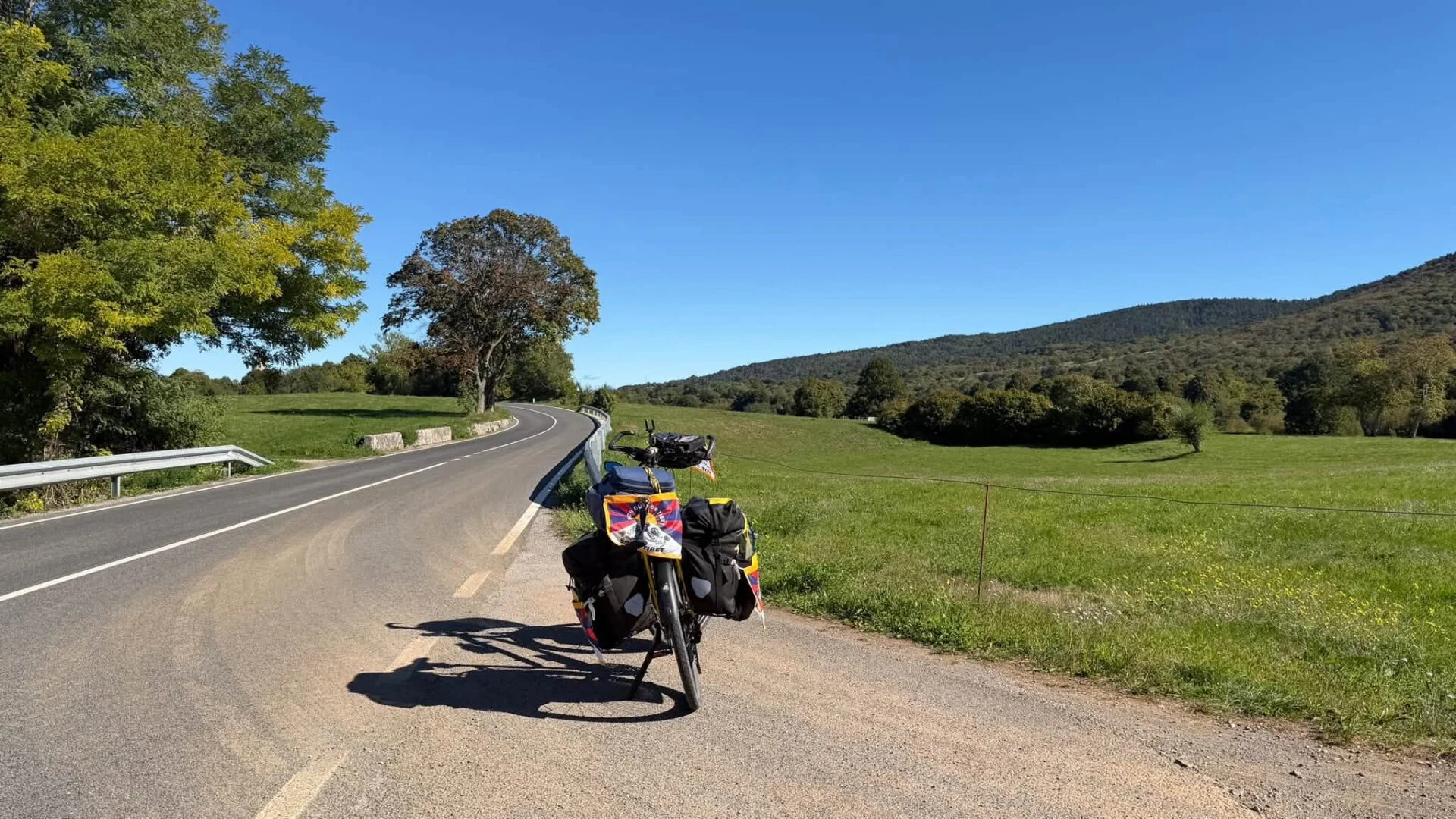
So going to the Old Town once more was left over. And this was the end of my Prague visit. Tomorrow back on my bike towards the German border.

16 September: Opening the door at Diamondway Buddhist Centre in Tallinn The centre's meditation sessions are open