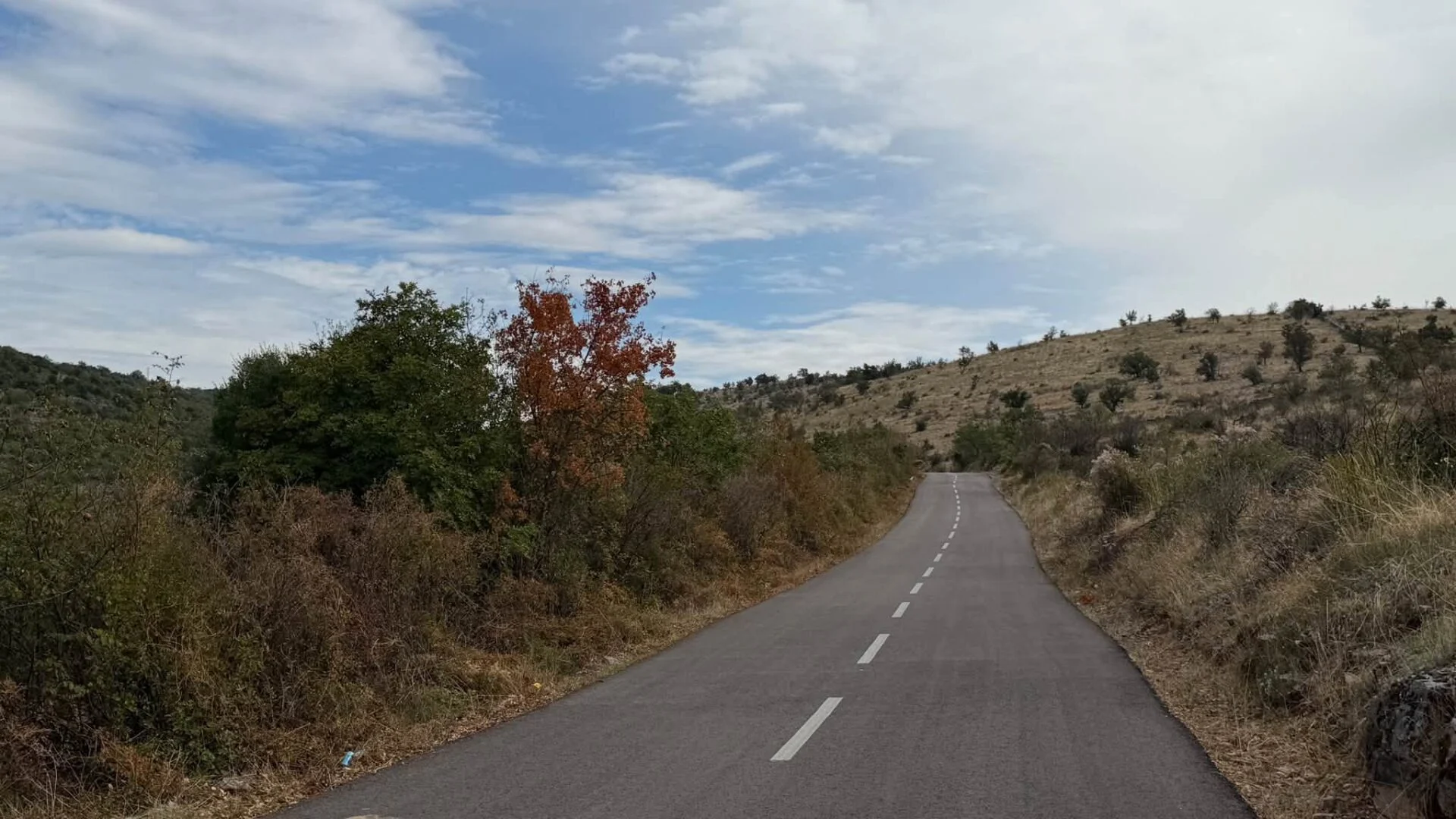
Bike tour 2023: Extremadura - Salamanca

12 April: Salorino- Cáceres (57.3 km - 590D+)
Today was a fairly easy ride, always along the N521, which is not a busy road with a wide hard shoulder for bikes. Apart from the first three kilometres from Paulo Cristóvão's farm to the main road. That compact dirt road through vast holm oak orchards is a true cycling delight!

The landscape of the N521 was rural with vast grassy plains and hillsides. The road went up and down constantly, which explains the fairly high number of altimeters.

After 30 km, I stopped in Aliseda for a drink and a tapa. When I reached the bar in the central square, it was almost empty. After about 10 minutes, however, the crowds started pouring in and the bar filled up completely. The bartenders were so busy that I did not even try to order a coffee after my 'ración' (meal-sized tapa).

Before I left, I asked someone what was going on in the village as I thought it was an ordinary weekday. They told me it was a festive day because they had their patron saint la Virgen del Campo celebrated.

A similar 'raid on peace and quiet' happened again when a bus full of senior citizens poured in while I was sipping a cup of tea in a hotel bar in Malpartida de Cáceres (see previous post)

Stork village

 Just before Cáceres I saw many storks' nests neatly arranged in a circle. A real stork village...

Although the route was relatively easy and I enjoyed my third day with strong tailwinds - which made me very happy three times - I felt quite tired when I made it to the Veletas hostel reached. After 247 km and 2,870 altimeters over four consecutive cycling days, tomorrow is time for a rest day in Caceres.

14 April: Cáceres- Cañaveral (44.1 km - 430 D+)
When I left this morning, I thought I would have to cycle another 65 km to the next affordable campsite. Quite a distance in this hilly landscape. And I changed direction (northbound) as the wind continued to blow from the northwest....The happy tailwind song was over.
In the village Cañaveral however, I came across a very nice hostel that was not on GoogleMaps, so I was able to stop after 44km without getting tired.

I even had time to go to a hairdresser and found one who had time to cut my hair very short.

Today's ride was stunning, especially the long stretch along the Embalse (reservoir) José Maria Oriol on the Tagus River.

15 April, Cañaveral - Plasencia (44.3 km - 410D+)

Because yesterday I stopped earlier than planned in Cañaveral I halved an 11km climb. This meant I had to start this morning with a 5 km climb to the pass of Los Castaños (493m).

For the rest of the journey, I kept following the N630, which runs parallel to the motorway and is called a 'service road' here. As a result, there is virtually no motorised traffic. On this road, I encountered more cyclists than cars.

One of these cyclists was José Francisco Prados García. We had been playing leapfrog continuously for some time, until we finally both ended up in the same track hotel for a drink. José Francisco lives in Motríl and often saw our late Belgian King Baudouin and his consort Queen Fabiola in town. They had a country house in Motril. Baudouin died there in 1993 of cardiac arrest.

All the way, I faced a brisk headwind which kept my average speed fairly low.

Puerta Trujillo - Plasencia

16 April: Plasencia - Puerto de Béjar (56.8 km - 730D+)
A former railway line has been transformed into a Via Verde, a compact gravel path for pedestrians and cyclists. It runs from Plasencia to Navalmoral de Béjar.

 It is a great route for slow travellers, with a rest area with benches at each former station.

Komoot indicated that I would have to climb 900m to Béjar (65km), but with a gradient that never exceeds 4%, that's gentle climbing. And the panoramas were fantastic!
Along the way, I met cyclists Bernard Datcharri and Valeria H. Mardones from bici:map. They told me that there is a good pilgrim hostel in Puerto de Béjar, so I would end my stage there. I was actually very happy to stop there, because after 25 km of non-stop climbing, even if it is no more than 3.5%, I was very tired.
Five kilometres before Puerto de Béjar, I met Bernardo, a 80-year-old hiking enthusiast, at a well.

He had walked here on foot and would now return to the village, a total of more than 10 km. A few years ago, he completed a 100-km hike organised here every year. I congratulated him and told him I was cycling to the Albergue Peregrino. He explained to me how to get there. About half an hour after I arrived at the albergue, I was getting ready in my room to take a shower, I heard him ask the person in charge of the albuerge if he had seen me. What a friendly person! I thanked him for his concern and wished him good luck and hiking fun.

Via Verde de Plasencia

17 April: Puerto de Béjar - Fuenterroble (35.8km - 410D+)
I spent the night in the beautiful Albergue de Peregrinos de Puerto de Béjar. This used to be a school, but it stood empty for years because there were not enough children left in the village. Mr Antonin, who still went to school here, turned it into a hostel. He welcomed me warmly on my arrival.

The hostel is run by volunteers and operates on free donations. On top of this hospitality, pilgrims get a free breakfast on top of it. I felt very grateful for so much hospitality.

Before leaving the hostel, I photographed some beautiful contemplative poems hanging on the walls there.

At Béjar I had to go through a rather long tunnel which was fortunately illuminated. Until Navalmoral de Béjar, where the via verde ended, the route was almost flat and I was able to cycle nicely smoothly. This was followed by a hairpin descent to the plain, where the wind picked up again and drastically reduced my speed.

When I arrived in Valverde de Valdecasa, where I found a bar that was open, I felt very empty and tired, as if something had suddenly sucked all my energy. My legs also felt helpless, I even had to walk some gentle slopes. Perhaps I haven't quite recovered from the long climb yesterday, so I decided to make it a short cycling day today and stop at the Albergue Santa Maria in Fuenterrobles. This was the very first albergue of this Camino route, founded by priest Blas de Amable y Pilar. The two passions in his life are developing the Via de Plata route for pilgrims and travelling with mule carts.

The atmosphere in the albergue was again very welcoming and enjoyable. Hopefully I will feel better tomorrow after a quiet afternoon and evening.

18 April: Fuenterrobles - Morille (31.7 km - 390D+)
At 07:00 we were at breakfast, again toasted bread with jam. I always eat muesli in the morning. In hindsight, I think my dip yesterday was due to the fact that I only ate toasted bread and not muesli. The glycaemic index of bread is higher than that of breakfast cereals, it 'burns' faster so blood sugar rises quickly and then drops deeply.As a precaution, I filled a jar with muesli and yoghurt today and ate it after 1.5 hours of cycling.

And thank God my energy and leg strength were back to their normal levels today. And that was much needed, because the first 17 km of the Eurovelo 1/Via de Plata route were about often very rough gravel paths where I could only push. I barely covered these 17km faster than my fellow walking pilgrims, we arrived at a bar in Pedrosillo de los Aires. Fortunately, I was able to follow paved roads from there until Morille. My plan was to cycle to Salamanca today, but due to the time and energy taken by the difficult paths, I decided to stop at the albergue in Morille. It is an unguarded hostel, I had to go and get the key and pay for the overnight stay at a local pub a little further down the road.
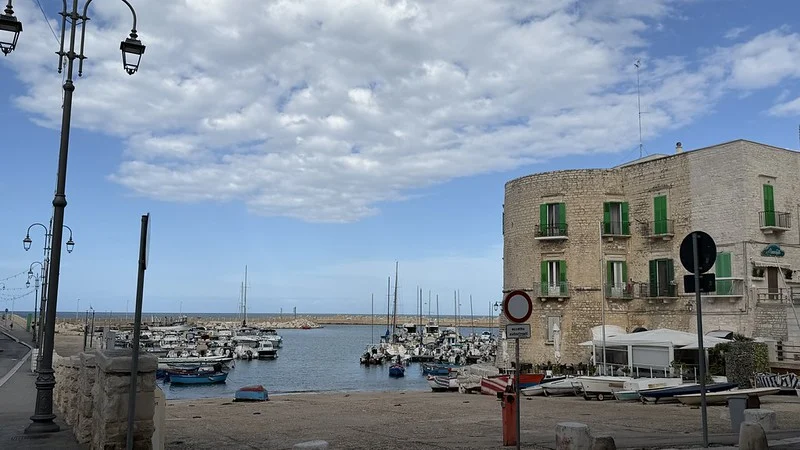
A cyclable stretch of the Eurovelo 1

April 19: Morille - Salamanca (21.7 km - 100D+)
Komoot promised that today would be a short and easy ride, and it was.

Just as I left the albergue, a herd of bleating sheep walked by. The last village building I saw was an odd tourist office, a sort of cabin under a tower of farm implements and machinery.
I then began a leisurely, mainly downhill ride through vast fields until I reached the city of Salamanca, which I entered via the old Roman bridge over the river Tormes.

Roman bridge to Salamanca
Share this post on social media

Read more...

en_GB