
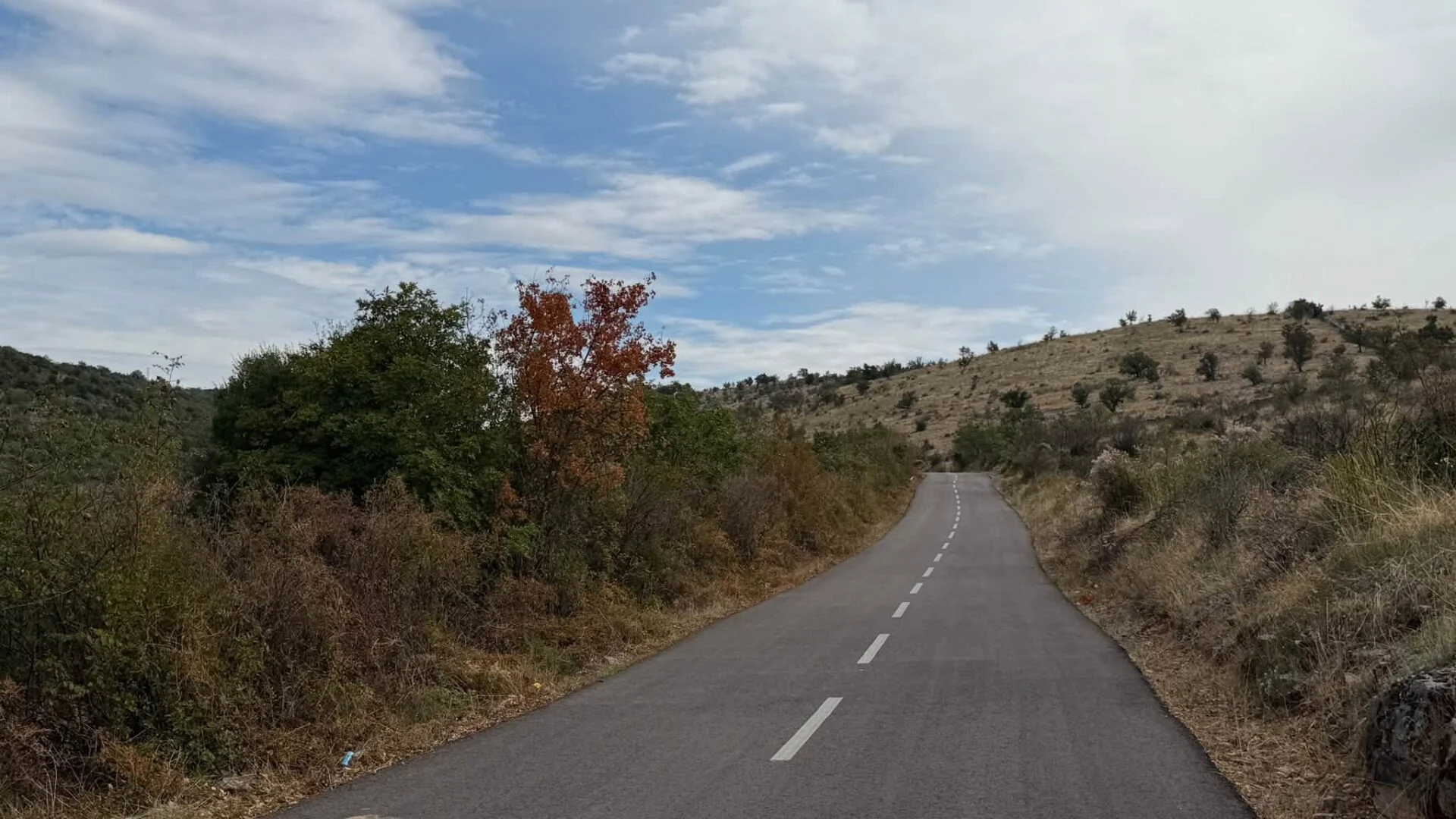
Around the Adriatic Sea 2026: Dubrovnik – Durrës (Albania) – Bari
The second leg of my cycle tour around the Adriatic Sea: the Balkan countries, probably as far as Dubrovnik in Croatia, perhaps even further…

27 - 29 March: Lisbon
I stayed in Lisbon for 3 days.
You can read more about it at the link below:
30 March: Lisbon - Ericeira (49.6 km - 620 D+)
Today's route was a cyclist's nightmare! To Lisbon coming out I did expect that it would be no fun in terms of traffic and that the road would be constantly going uphill, but what followed was even worse: through suburbs with tall apartment buildings reminiscent of the former Eastern Bloc, constantly steep up and down, no bicycle lanes, heavy traffic and very bad air due to all the exhaust fumes.
The last 15 km were easier as I descended towards the sea, but again along a busy road.
Today was the worst cycling day of my entire trip so far, I think. Hopefully this was the first and the last.
Arrived at Olive 3 Ericeira Hostel it was like going from traffic hell to heaven. The hostel staff were super friendly, there was a peaceful garden, a common room and kitchen that felt like home. There was even a fully equipped yoga studio for guests to use. I would have loved to have stayed a second night, but they were full.
To get all the bad car fumes out of my lungs, I spent about an hour on the beach before dinner to breathe in the fresh sea air.

31 March: Ericeira - Ribeira de Pedrulhos (33 km - 510D+)
I had until 12pm to check out at Olive3 Ericeira Hostel and gratefully used this time to do an extended yoga session in their studio before breakfast. This is soooo beneficial for body, joints and mind.
I left Ericeira around 12am and before going inland to Ribeira de Pedrulhos, I spent some time on a bench watching the waves of the Atlantic Ocean.
At Ribeira de Pedrulhos, a small village near Torres Vedras, Geertje and Ernest were expecting me around 5pm. They are the founders of 'No Pega Mon', the foundation I worked with during my first two bike rides to benefit No Pega Mons educational project in Bubaque, Guinea-Bissau (Nordkapp in 2018 and Great Britain/Ireland in 2019).
I am happy to rest here for a few days because the itchy throat and dry cough I had during my first days in Portugal have returned after the suffocating 'choke hold' drive from Lisbon to Ericeira.
The shortest way to Ribeira again sent me over several dust roads with many walking-biking sections, so when I saw a connecting road to the N9, I took it and made a cyclable diversions of about 10 kilometres to reach the village.For 7 km we followed the Raya Real, a 70-metre-wide dirt path through pine forests formerly used by cattle. It led in one straight line to the royal palace (Palacio del Rey), a former hunting resort of the royal family.
At 13:30, it started raining and we had to take shelter under a pine tree to eat our lunch.
Then we had to walk another 5 km to the pilgrimage site of El Rocio, with the famous 'Ermita de Santa María de Las Rocinas'. Every year in the last week of May, 1 million people, mostly on foot or horseback, travel to this village to venerate the Virgen del Rocio.
Because there are so many horses in the village, it has no paved roads. It felt a bit like a village in a western movie.
All in all, we hiked 18 km today, mostly in loose sand.

4 April: Ribeira de Pedrulhos - Alenquer (34.3 km -380 D+)
After saying goodbye to Geertje and Ernest, I set course for Alenquer, the first town on the way with a campsite. My cycling fitness is still a bit below par, so I'm taking it easy until I feel stronger again.
The first five kilometres to Torres Vedras went along a smooth gravel path along a small river. Very nice and quiet cycling.
After Torres Vedras I took the N9, a road with one lane in each direction and no bike lane. Not pleasant and safe for cycling, but fortunately there was little traffic.
The first 20 km were mostly uphill. In Merceana I drank a Tonic and chatted with an old man who spoke no English. He said the last 10 km to Alenquer would be flat, and fortunately he was 90 per cent right.
I arrived around 15:30 at Camping Alenquer and had plenty of time to relax and do my stretching exercises in the sun.
5 April: Alenquer- Escaroupim (47.2 km - 280 D+)
When I went to the toilet this morning, I could not flush the toilet. There was no tap water either. The water had been cut off and that would last until 3pm, without any prior warning! The campsite owner, a friendly but somewhat chaotic man, brought me a bottle of Evian so that I had enough water for breakfast and on the road.
Komoot promised me a flat ride with only 140 altitude metres. After Alenquer the landscape indeed became flatter.
I was hoping the Komoot route would be quieter than the GoogleMaps alternative along the N9, but that was wishful thinking. The N3 went through an industrial area and there were a lot of big trucks. But it had a wide hard shoulder, so cycling was more comfortable and safer. On cycling-unfriendly roads in Portugal, people are already happy with few

On the chimneys of a factory next to the busy N3 I saw many storks' nests. These birds are apparently not looking for romantic nesting sites....
At Azambuja, a city that is not exactly in a very attractive hiking area, I saw several backpackers. A little further on, I saw the explanation of their presence: a sign from the Camino de Santiago.
Beyond Azambuja I was able to leave the N3 and follow a quiet local road along a railway. Finally the kind of roads every cyclist longs for!

To the Tagus to cross, I had to cross a 1km-long iron bridge with a pedestrian path on the left, a single lane for cars in the middle and a very narrow cycle path on the right. The car lane was too narrow for both a car and a bike, and the bike path was quite narrow for my packed bike. I did not dare follow the cars, because if I could not cross before the cars from the opposite direction entered the bridge, I would obstruct all the traffic. So I had to walk very carefully with my bike on the narrow bike path, which offered only 5cm clearance to the left and right of my panniers.
In the middle of the bridge, two cyclists came from opposite directions. My goodness, how would we pass each other!? They were young. When the bridge was momentarily car-free, they jumped over the railing, lifted their bikes over it too, and past me they climbed to the cycle path again. I was very grateful to them for wanting to do this.
After the bridge, I had to cycle another 4 km on a gravel road to the campsite, the last 2 in hike-a-bike mode as the gravel became too sandy again.
April 6: Escaroupim - Golegã (51km - 140D+)
It was a beautiful ride, mostly on rural roads, apart from the first 4 km. From the campsite, which is in a large forest, I had to push and plough my bike for 3.5 km through very loose and deep sand, up to the village Muse. It took me a full hour and a lot of sweat. But I enjoyed the beautiful forest.
After 4 km on the N118 after Muse I could follow a very damaged tarmac road, with a river with many waterfowl on the right and endless fields and vineyards on the left. I think the Tagus Valley is Portugal's wine cellar. Unfortunately, the many potholes in the road prevented me from watching the river birds while cycling.
In a nice picnic park with benches by the river in Alpiarça I ate my lunch and drank coffee in the small bar.
Beyond Alpiarça I followed a very smooth provincial road through the fields. A cyclist's heaven.
It is striking how many dilapidated barns and farms there are in this region.

For Golegã I had to use the Tagus crossing again via a similar iron bridge as yesterday, but this time the motorway was wide enough for both cars and bikes.
Golegã is a very authentic old village. It is the 'horse capital' of Portugal. Every year a huge show of Lusitano horses is held here in November. The village was also often visited by the famous Portuguese writer José Saramago, born in nearby Azinhaga.
By Portuguese standards, it is Parque de Campismo Municipal da Golegã a clean, well-maintained, well-appointed and cheap campsite. I pitched my tent under a tree with a very delicate perfume of blossoms. Very pleasant place! I ended up staying there for three nights to visit the village.

10 April: Ortiga - Castelo del Vide (65.2 km - 780)
Today I had a very bad experience, the first of its kind during this eight-month journey. And hopefully the last....
After a tiring drive of almost 60 km, I arrived at Camping Quinta do Pomarinho. It was a Dutch farm campsite. I was happy because I love those small-scale Dutch campsites.
As I cycled up the driveway, there was a sign that the campsite was full, but hikers and cyclists are always welcome - at least that has been my experience so far.
Not at this campsite. There was enough open space to pitch a tent, but the Dutch owner said he had reached the maximum number of campers allowed and would not exceed that number. I begged him and said I was very tired, but he was merciless
A nice Dutch couple had offered me to stand behind their camper in case the man rejected me - they had also had a bad experience with him the day before when they arrived - but no way, he threw me out.
The nice couple gave me a bowl of soup and a juice before I got back on my bike. What a contrast....

The next campsite was about 20 km away, too far for me as it was already 6pm. I therefore decided to drive back to Castelo de Vide, a tourist town with lots of accommodation. On the way there, I would look for a wild camping spot, and if I didn't find one, I would definitely bed in Castelo find. I found no camping spot; all the estates along the N-246 were fenced off. Then I climbed the last steep 180 metres of the day to Castelo, which is built against a hill.
But apart from this mishap, the road today was magnificent: first a long and steep climb out of the Tagus Valley, then a 20-km plateau through nature with a nice tailwind, a few kilometres on a rideable dirt track - with some gates that I was lucky to be able to open - and a passage through a strange, rocky moonscape that reminded me of The Burren in Ireland. Later, Geert Barbier told me on Facebook that these rock formations were created by glaciers millions of years ago. And look, just like in Ireland, a little further on I saw a beautiful hunebed. I love these prehistoric cemeteries, there is always a very special energy.

11 April: Castelo de Vide - Salorino (68.3 km - 830D+)
Yesterday's negativity because of the refusal on campsite Quinta do Pomarinho was compensated 300 per cent today thanks to all the friendly and helpful people I met.
Antonio, whom I met on the road in São Salvador da Aramenha referred me to his friend Paulo Cristóvão at Salorino (SP) to seek shelter in that village. The waitress in hotel Casa Cuartel in San Vicente De Alcántara, Extremadura, Spain, prepared a salad for me while the kitchen was already closed. The villagers in bar An Ca' Juli at Salorino showed me on the GPS how to reach Paulo's remote farmhouse. Then there were the muralist Sojo JC (Sojo.JC on Instagram), who actively contributes to the charm of this village with his ultra-realistic paintings; the old shepherd in Salorino who posed for a photo with his sheep and proudly told that he had been a shepherd for 32 years, and finally Paulo and his daughter Inez, who offered me a bedroom and dining space in his farmhouse.

Today's route was again very beautiful, but in some parts I had to push my bike because Komoot had again lured me into taking small but very steep shortcuts. Fortunately, after about 8 tough kilometres I was able to get back on the main road to Spain.
In Extremadura, the landscape became more open and the slopes 'softer'. For kilometres in a row, I cycled through rocky landscape, passed a beautiful lake and followed a long stretch of gravel.
The last 20 km of San Vicente to Salorino I had to climb to the Elice Pass.
In Salorino, known for its numerous murals, I photographed all the paintings I passed and had a brief chat with Sojo JC, one of the street artists (Art with a capital letter). He told me that several artists come to this village to paint a mural. The murals illustrate the fauna, flora and traditions of the village.
From bar An Ca' Juli I called Paulo and he told me I could spend the night at his place, 4 km further along the N251 and then another 3 km inland on a dirt road. Which brings my total today to 68 km.
The second leg of my cycle tour around the Adriatic Sea: the Balkan countries, probably as far as Dubrovnik in Croatia, perhaps even further…
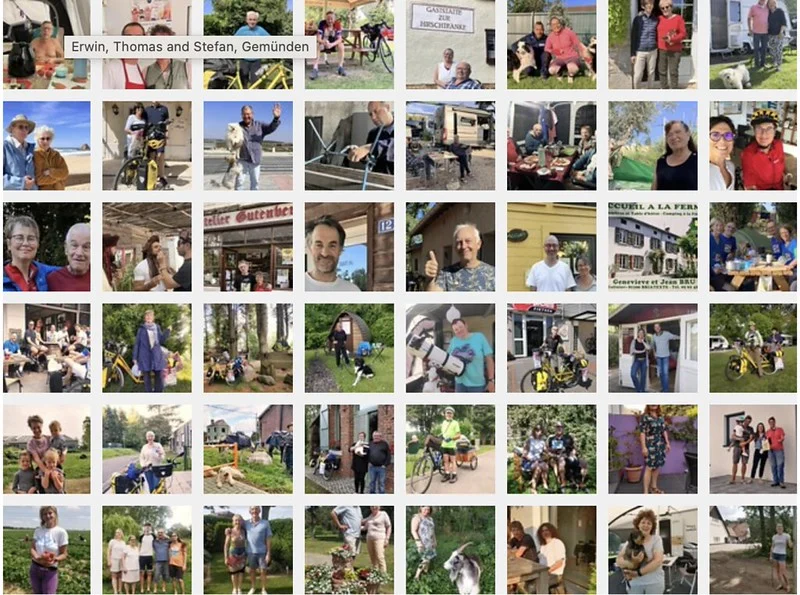
On my travels, I meet so many friendly, helpful and hospitable people.
They deserve a hall of fame.


