30 Sept - 1-2 Oct: silence weekend at Tushita meditation centre
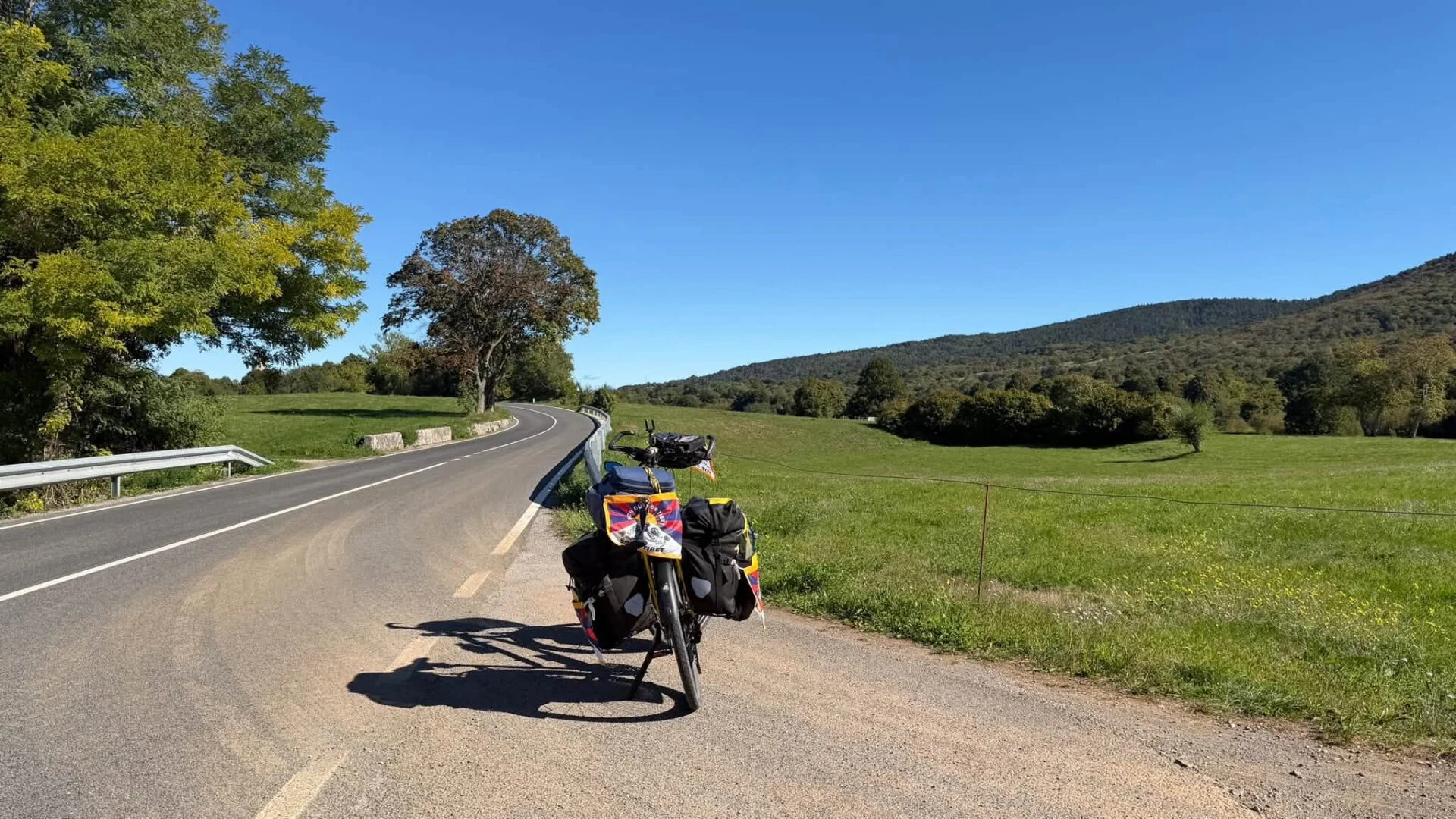
Friday evening a little before 18:30 I arrived at the Tushita meditation centre, just in time for the welcome by director Alberto Gamez. Tushita is in the highest part of Viladrau and, as in most villages, a final, very steep slope awaited me to get there.
But what a paradise! That high altitude means there is virtually no traffic and very little village noise, apart from some barking from the neighbour's dog. The domed terrace of the centre overlooks an imposing mountain. For summer retreatants, there is even a swimming pool. The Gompa (meditation room) is big enough for over 20 people. So is the accommodation to stay overnight. Meals are vegetarian, organic and prepared on site.
The guided meditation sessions Saturday and Sunday, eight in total, focused on achieving mental peace and calm.
As announced on the website, the sessions were in Catalan. Broadly speaking, I was able to follow because there were many parallels with the silent retreats I attended at Ehipassiko Antwerp/Mechelen followed in Belgium. The Q&A sessions were more difficult to understand because these were sometimes about very personal experiences.
Here's a quick rundown of the explanation and instructions, or at least what I think I understood from it.
Marina Brucet, spiritual director of Tushita, first explained that meditation is more than just a pleasant relaxation technique, as people here in the West often think. During meditation, you try to nurture and cultivate the positive aspects of your mental and emotional life (compassion, loving-kindness, patience, attention, modesty...), while extinguishing the negative aspects (anger, hatred, selfishness, indifference, impatience, contempt...) by not immediately acting on them when these emotions overwhelm you. By suspending your reactivity, you notice that the negative emotion is not in the objective outside world, but rises within yourself. And that you can therefore learn to control it. Through meditation, you learn to deal with these emotions and redirect them to their positive opposite. In this way, you yourself become more relaxed and happy in life and become a more pleasant person for others and for society as a whole.
Subsequently, the Marina the correct sitting postures and focused on certain aspects that can hinder the achievement of mental peace while sitting. Restlessness and resistance can arise from unpleasant sensations in the body, such as sleeping feet or legs for meditators sitting in cross-legged or kneeling position, back pain, tension in neck or shoulders due to sitting in the same position for a long time, etc. Marina explained in detail how to deal with these. In a nutshell: do not develop resistance or aversion to these physical discomforts, as this will only exacerbate them. Observe them calmly, accept that they are there, relax the part of the body where they occur and then turn your attention back to your meditation object, in this case the breath. After a while, you will notice that the discomforts soften, because a sensation is not eternal and is also subject to change. If physical discomforts do not improve, you can make some subtle movements or change your sitting position.
Marina also stressed the importance of keeping the middle ground between too much forced sitting, which causes tension and closes the mind, and too much relaxation, which leads to sleepiness. Meditation is all about being awake present and looking with an open and unbiased mind at all that presents itself here and now. Without judging it or reacting to it with aversion or craving.
Then there are the mental jammers, something everyone, including advanced practitioners, has to deal with: intrusive and jumpy thoughts that incessantly assail your mind, even if the external conditions are conducive to achieving mental calm, as here in Tushita. Or difficult and overwhelming emotions such as anxiety, sadness, stress...
Again, try not to react to it. Just notice that a thought or emotion is there, observe it for a while and don't act on it any further. Certainly don't start building on it with hypothetical if/then thoughts. Return to breathing. By observing the thought or emotion from a distance, letting go and returning to your meditation object, you create breaks between thoughts. And this again and again whenever a new thought arises. Meditating is starting over and over again, until the breaks between thoughts become longer and you achieve more mental peace. This doesn't happen overnight; it takes a lot of practice, patience and persistence. And leniency towards yourself. Above all, don't be angry with yourself when it 'fails again'. That is normal. Just start again.
The final morning session Saturday closed Marina with half an hour of Qigong exercises. To get the chi energy flowing freely again and loosen up any stiff limbs.
Between cycling and all that comes with it, this silence weekend was a very beneficial rest. It was actually a bit of coming home. To continue tomorrow with renewed energy.
And many thanks to Marina and Alberto for the extra night's stay, so I didn't have to go looking for a place to sleep late in the afternoon.
Muchísimas gracias por todo!
More info: http://tushita.es/en/

16 September: Opening the door at Diamondway Buddhist Centre in Tallinn The centre's meditation sessions are open