Lithuanian fields
First strongly hilly to Kalvarija, where I visited the church and had a salad.
Few real villages along the way. At most a few houses and a farmstead here and there. As a result, few opportunities to sit down somewhere. Few bus stops to take a break either, and most don't have a bus shelter. So in case of rain, it will be difficult to find a shelter.
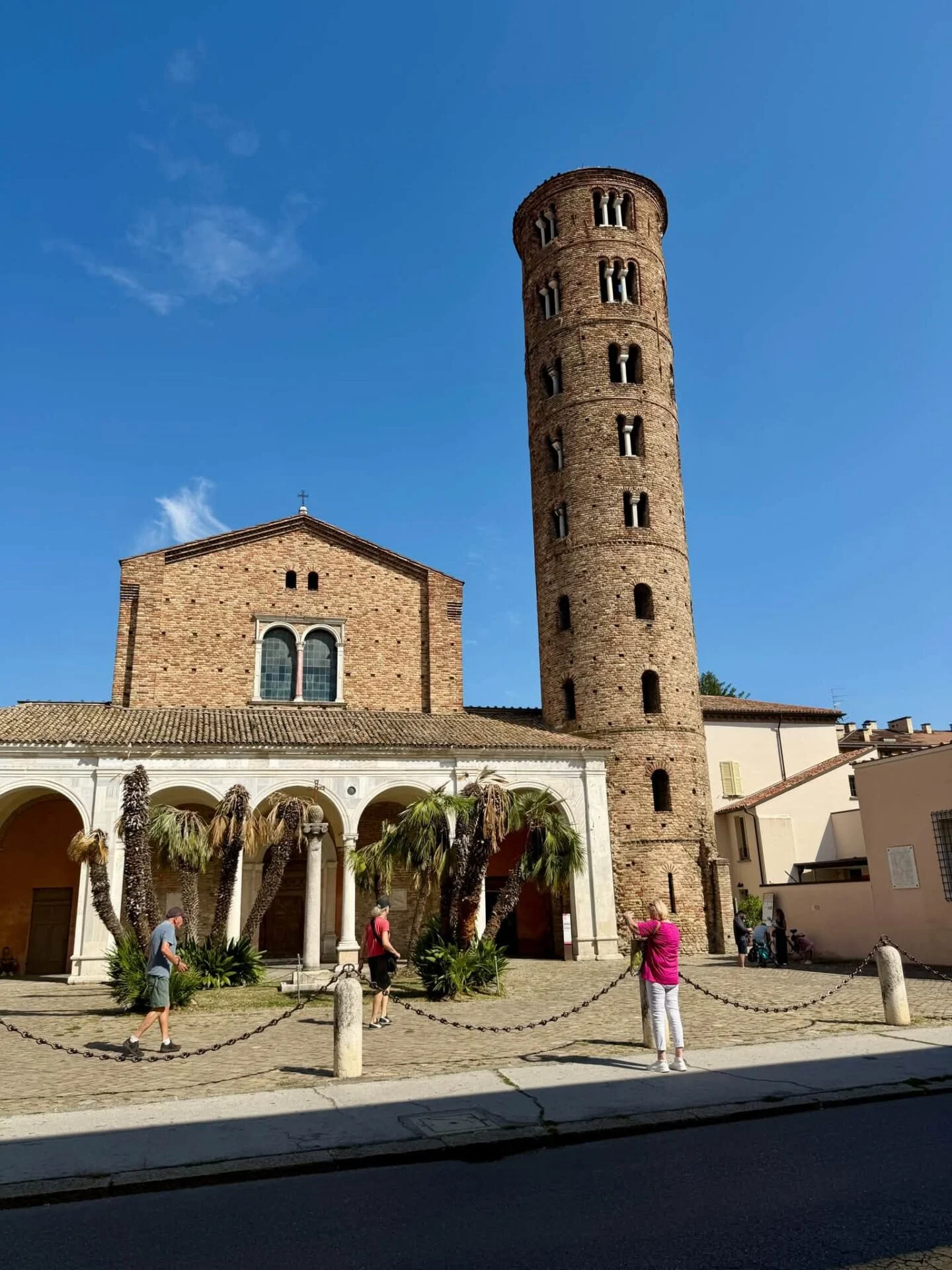
The architecture of the church is completely different from Poland. No red brick and no stepped gables.
On the other hand, there are many, and also motorcyclists, who honk their horns and give a thumbs up. Maybe it is because not many bikepackers ride the roads here.
On the way, I saw one of those brown signposts to a monument 200 metres from the track. Curious, I turned into that little road, but I did not see any monument, only some ponies.
Church of Kalvaija
Bukonys campsite had no reception. I called one of the announced numbers and was given the necessary explanation to set up. Later, someone would come by to receive.
I put myself close to the toilet, which is convenient for at night. Moreover, next to the toilet was a well-equipped kitchen with all comforts.
Bukonys campsite
According to info panels (thanks to GoogleLens I could read them), wolves, wild boar, red deer, stags and vipers, among others, live in the area. There are also said to be moose roaming around, which maintain the wood stock in the marsh. On the walkways across the swamp, I saw only a few salamanders sunbathing.
In terms of vegetation, the carnivorous plant sundew, which is also found in our Kalmthoutse Heide, would also grow there. The wet heather was already blooming somewhat.
For such a small town, it did have a big cultural centre.
From Prienas it was another 8 km to Birštonas, where the last campsites before Vilnius were located.
I don't regret that. After swimming, I still had to go to the supermarket and cycled past Brištonas first. That's not a village but a big spa around several natural mineral springs. There were several sanatoria working according to Kneipp's vision. That is based on water and herbal therapy, exercise, foot reflexology on a barefoot path with different substrates, and healthy eating. There were also some fancy eateries, sports facilities and a pleasant walking path alongside the wide Nemunas river. In short, anyone who wants to do a health cure, this is the place to be!
Black cows grazing the vast plain.
After 40 km there was an option to switch to Eurovelo11, but after 1 km on that route I had already climbed into complete muscle acidification twice. I didn't fancy that for another 60 km and turned right around to the A16, which also hiked sharply but never so steeply that I soured after only a few dozen metres.
Those two gifts were gratifying during such a long, monotonous and arduous ride!
One of many calves bites along the way
I gave them a flyer and explanation of the Dalai Lama's SEE Learning project, and barely 1 minute later a 50€ note came my way. What generosity!
The Indonesians expressed great admiration that, given my age, I was still travelling on a non-motorised bicycle. For a woman, that was very unusual in their culture. I was also given sugared fruit sweets for energy, two packets of instant coffee and a packet of noodles, all brought from their homeland. And a sticker of their Nordic Ride and Latitude Seekers motorbike club.
Indonesian Latitude Seekers motorbike club
Monday evening at 7pm I had arranged to meet Robertas and his friends from the Vilnius Tibet support group. He could not have chosen a more symbolic meeting place: Tibet Square in the heart of the old town.
Robertas and I
On the road in the village Suderve Robertas showed me a remarkable round, neo-classical church that was presumably designed by the same architect as Vilnius Cathedral. Being as long as it is wide as it is high, the church is said to have great acoustics and many concerts are held there. On the hill surrounding it is an old cemetery. A very special place that exudes a calming energy.
Church of Dūkštos in red brick
After a short lunch break in Elektrenai Komoot sent me 5 km wrong. Instead of going to a campsite, it sent me straight into a lake. As a result, I had to cycle another 8 km into a headwind.
Sunset on the lake at Camping Vigio Brasta
By car about 50 km on the motorway. By bike almost 15 km further. A slow ride, with an average speed of just 12.5 km/hour. The cause? A stiff headwind and 14 km of archaic coarse gravel roads, with sandy stretches where you slip, pits, roots, boulders and those ridge patterns you also see on sandy beaches. I was well shaken there because I have no shock absorbers. Fortunately, my spokes survived this misery. Why can't they make their gravel roads here more bike-friendly, like in Poland?
Part of that cycling nightmare ran partly along the LT02 cycling route. This was also used by many motorists, so you were in a cloud of dust every time. So be it, I got to my hostel in time in Kaunas hit.
Miserable gravel road
During my stay in Kaunas, I visited the Ciurlionis Museum and Kiemo Galerija visited. Also did a city tour which you can read more about in a separate blog.
A day of many emotions and a special meeting.
Zen bikes on the 2008
Karsten Rinck and his dog Lotte
Yet another proof that a person can live a perfectly happy and meaningful life without all the unnecessary junk that commerce tries to foist on us all the time.
Swimming pond at Camper Place Pajiešmeniai-
Fortunately, the high season is over and there were not many caravans.
Latvia!

16 September: Opening the door at Diamondway Buddhist Centre in Tallinn The centre's meditation sessions are open